
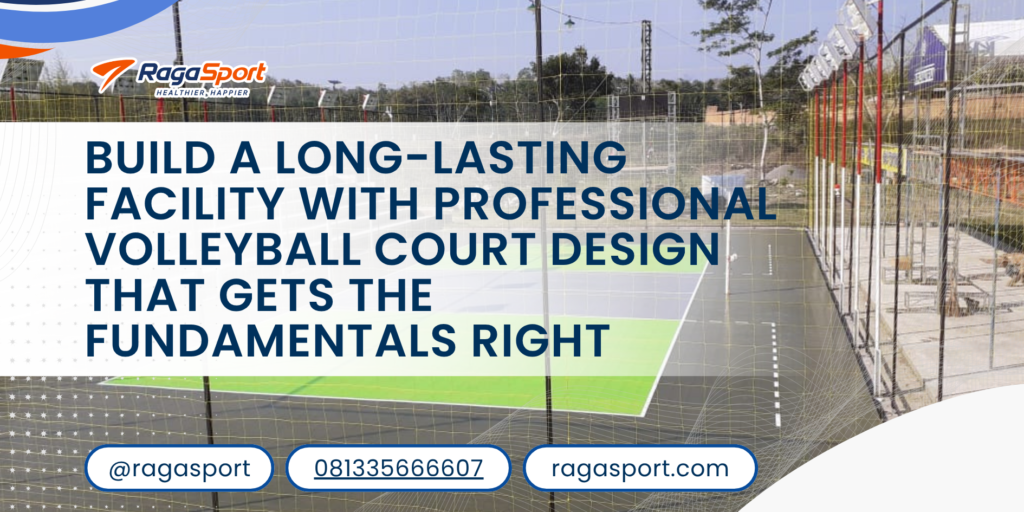
Across Asia, sports facilities are popping up everywhere. From schools upgrading their grounds, communities building shared spaces, and companies adding courts as part of CSR programs. It sounds promising, right? So, it’s no surprise that this surge puts more attention on getting the volleyball court design right from the start.
However, many projects fail early. Within just 2 – 3 years, issues like cracks, standing water, and uneven surfaces start to show up. Why does this happen? In most cases, the problems are poor land preparation and poor civil engineering. Want to avoid this? Keep reading!
Table of Contents
7 Critical Ground Preparation Factors for Volleyball Court Design
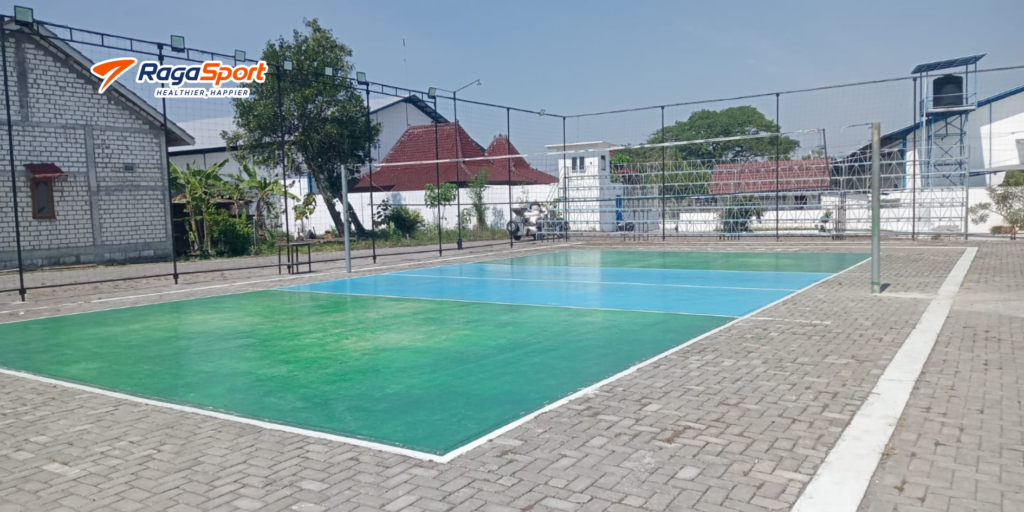
Before you move into surface materials or finishing, these ground preparation factors are what truly determine how well your court performs over time:
1. Site Clearing
A solid volleyball court design always begins with a clean and level surface. The ground should be completely flat, with no bumps, loose soil, or hidden debris that could affect player safety or ball movement.
Make sure the base is thoroughly cleaned before any application begins. Eliminate oil stains, dust, and loose debris that could interfere with proper adhesion. For concrete surfaces, use acid etching or mechanical grinding to open the pores, allowing the primer to bond more effectively.
2. Soil Compaction and Load Testing
Next, ground stability is improved by compacting the soil with heavy rollers, which helps eliminate air gaps and reduces the chance of future sinking or uneven settlement. This step ensures the foundation becomes dense enough to support continuous athletic activity.
For optimal results, compaction should reach at least 95% Modified Proctor Density (an industry benchmark for sports facilities). To validate performance, load testing such as a Plate Load Test is often carried out. This helps confirm whether the ground can handle long-term use
3. Base Construction
A strong volleyball court design starts with a properly constructed concrete or asphalt base, typically using M20-grade concrete to create a stable foundation for subsequent acrylic layers. After pouring, the slab must undergo natural curing for at least 21 days to achieve full structural strength and minimize internal moisture.
Once cured, the base becomes firm and resistant to cracking, providing a reliable platform for long-term use. A consistent slope of around 1:100 is also essential to ensure effective drainage and prevent water accumulation.
This is especially important for indoor volleyball facilities where moisture control and surface uniformity directly impact play quality. An additional best practice is conducting a moisture vapor test before coating, as trapped moisture can cause delamination over time.
4. Patching and Leveling
After the base is ready, you’ll usually still find small dips or uneven spots where water can sit. These need to be fixed right away using a leveling mix made from binder and fine aggregates so the surface feels truly even. In a proper volleyball court design, even tiny irregularities can mess with ball bounce and player movement.
Next, leveling is fine-tuned with laser tools to keep a gentle slope of about 0.5 — 1% so water drains naturally instead of pooling. Before moving to coating, many contractors also run a simple straightedge check to catch any small deviations.
5. Crack Repair & Surface Preparation
Before moving forward, the base needs to be fully stabilized. Small cracks and joints are sealed using acrylic fillers to prevent them from expanding over time. Any uneven or raised areas are then ground down to achieve a consistent surface.
6. Applying Resurfacer Layer
Once the base is clean and stable, a resurfacer layer is applied. This mixture, typically combined with fine silica sand, helps smooth out minor imperfections that aren’t visible at first glance but can affect performance. It also creates a uniform layer that improves the bonding of subsequent coatings.
7. Applying Final Surface
The finishing layer determines how the court looks and feels in use. Here are some surface options worth considering for your volleyball court design:
- Acrylic flooring: durable, slip-resistant, and widely used
- Flexipave: offers better cushioning and player comfort
- Vinyl: ideal for controlled indoor environments
- Interlock: modular and easy to maintain
Read more: Best Volleyball Court Companies Near Me: A Comparison Guide
Drainage Architecture: Designing Volleyball Courts That Stay Dry in Tropical Conditions
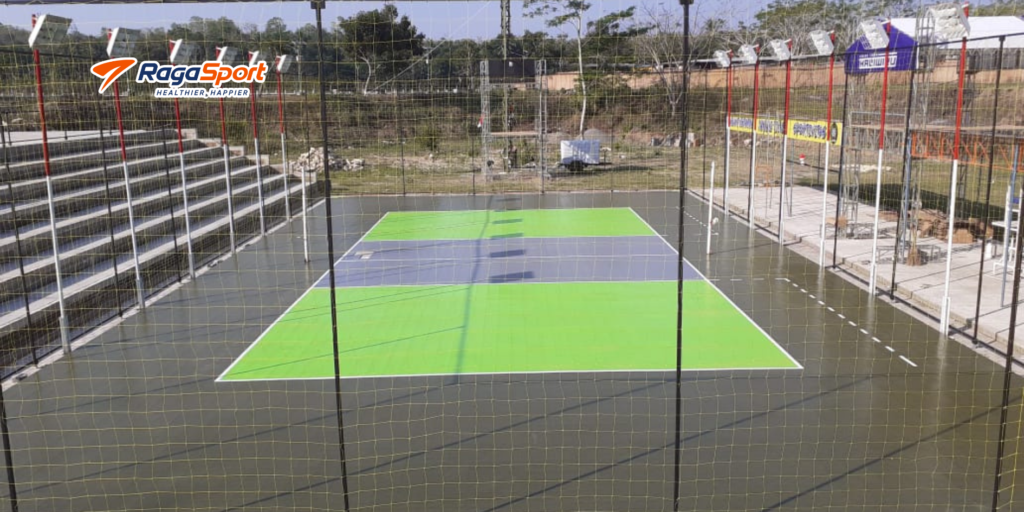
In tropical climates, like Indonesia and countries in ASEAN, an effective drainage system is important to your court playable year-round:
1. Drainage Infrastructure Components
A reliable volleyball court design starts below the surface. Perforated PVC pipes (around 10–20 cm in diameter) are installed in patterns such as zig-zag or a center line, depending on how quickly water needs to be discharged. These pipes are aligned with the natural flow of water, helping channel it away efficiently.
But pipes alone aren’t enough. A gravel layer (typically 10–15 cm thick) using pea gravel sized around 5–15 mm, acts as a fast-draining medium while stabilizing the base. To keep this system from clogging over time, a geotextile fabric is added as a separator, preventing fine soil or sand from infiltrating the drainage layer.
Equally important is the surface slope design. A gentle slope of about 0.5% to 1% ensures water naturally flows toward the drainage system instead of pooling on the court. Without this, even the best subsurface setup can underperform.
2. Drainage System Types
For standard courts, a perimeter system is often sufficient. However, larger or high-use courts benefit more from a center spine system, where the surface is slightly angled toward a central drain line for faster water removal. For more demanding environments, subsurface filtration systems using geocomposite layers can further improve drainage efficiency.
Make Your Beauty Decision with Powerful Volleyball Court Design
A volleyball court might look simple on the surface, but the real challenge lies in getting the fundamentals right from the very beginning. A well-planned volleyball court design helps you avoid common pitfalls like drainage failure, surface cracks, and costly rework.
Whether you’re building for a school, community, or corporate facility, every decision, starting from the ground structure to the finishing layer, has a direct impact on long-term performance. That’s why having the right strategy and expert support makes a difference.
Ready to move forward? Consult your project with Ragasport team and make sure your court is built to last from the ground up.