
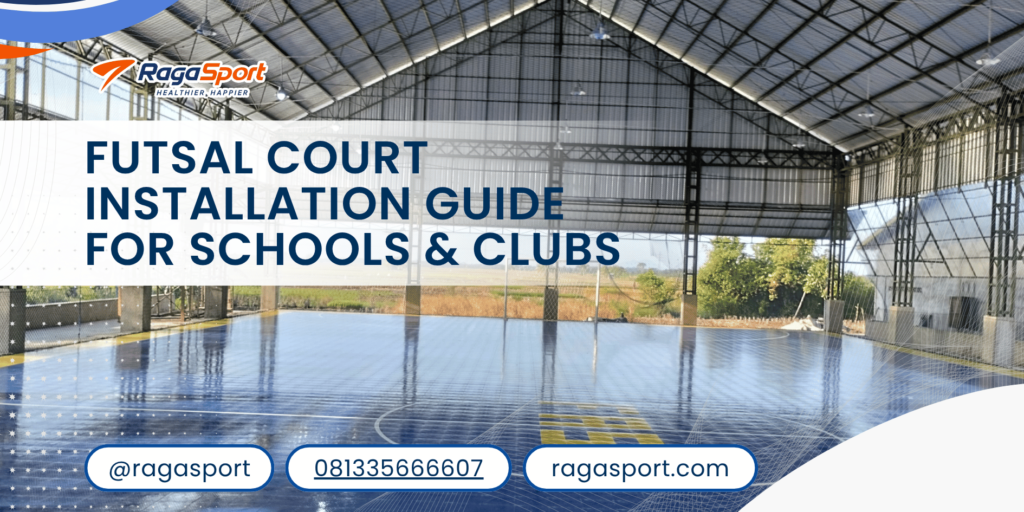
Futsal courts have become one of the most in-demand sports facilities in schools and clubs, driven by the growing popularity of the game and its accessibility for all age groups. However, many decision-makers still wonder what the exact process looks like when planning a proper futsal court installation from start to finish.
Especially for those of you considering an indoor futsal setup, additional factors such as ventilation, lighting, and structural design also play a critical role. In this article, Ragasport will walk you through the essential steps and considerations to successfully build a futsal court that meets both functional and professional standards.
Table of Contents
7 Stages of Building a Futsal Court for Schools & Clubs
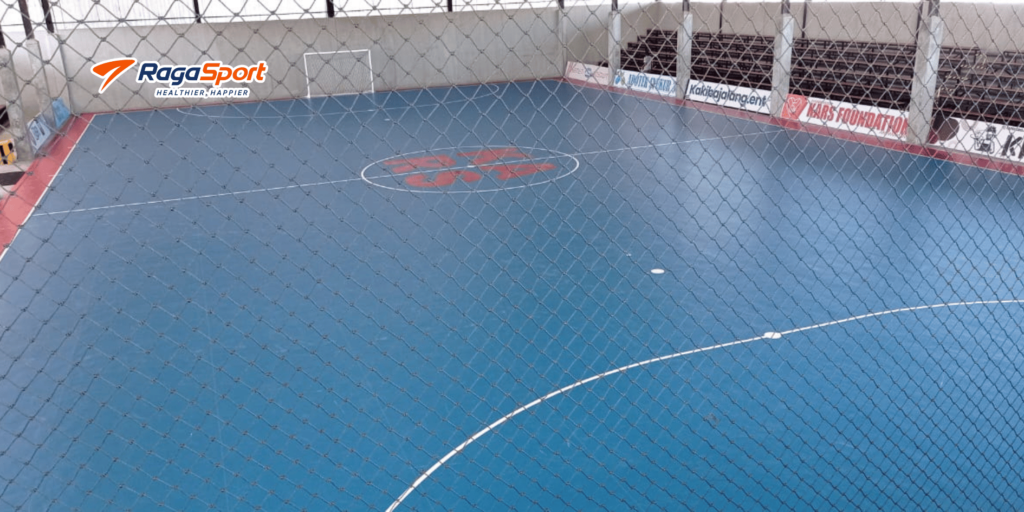
The stages of futsal field construction include structured steps that must be followed sequentially to ensure the field is of the highest quality. Here’s how to build a futsal field properly:
1. Determining the Type of Futsal Court
Before starting a futsal court installation, key stakeholders such as the school principal, teachers, student committees, and other relevant parties, must first decide the type of court that best fits the available space and usage patterns. This decision impacts scheduling, maintenance, and student accessibility.
Indoor Futsal Court
- Built inside a covered hall or gymnasium
- Uses vinyl, interlock sport tiles, or synthetic grass
- Protected from weather, allowing consistent use for PE classes and extracurriculars
- Ideal for schools with year-round sports programs
- Often part of a structured indoor futsal setup
Outdoor Futsal Court
- Located in open school yards or sports fields
- Commonly uses synthetic grass
- Requires proper drainage to prevent flooding
- More cost-effective but dependent on weather conditions
For schools with limited land, indoor courts offer better scheduling control, while outdoor courts can accommodate larger student groups simultaneously.
2. Site Preparation
A proper futsal court installation begins with preparing the land to ensure safety and long-term durability. In a school setting, this step must also consider surrounding infrastructure such as classrooms, walkways, and student activity zones.
The area should be cleared of debris, vegetation, and obstacles. After that, the ground must be leveled to achieve a uniform surface. If necessary, excavation or filling is performed to reach the correct elevation. For schools, it’s also recommended to include buffer zones around the court to prevent accidents and allow safe movement of students and teachers.
3. Court Drainage System Setup
Drainage is essential for maintaining usability, particularly for outdoor school courts. A well-designed system ensures rainwater flows away quickly and does not create puddles that could disrupt activities or cause slipping hazards.
Drainage channels are usually installed around the perimeter and connected to a main system. In schools, this is especially important to avoid water spreading into adjacent areas like walkways or classrooms.
4. Flooring Material Selection
Flooring plays a major role in safety and comfort, making it a critical decision in any futsal court installation for schools. Synthetic grass is a popular option because it is soft, reduces injury risk, and is suitable for both indoor and outdoor use. It is also relatively low maintenance, which is ideal for school management.
Interlock sport tiles are often used in indoor school halls due to their durability and easy replacement system. They can handle high foot traffic from daily student use.
Vinyl flooring is commonly chosen for higher-end school facilities, especially those that host competitions. It provides a smooth and elastic surface that enhances comfort and performance.
Read more: Best Futsal Court Flooring: What Top Facilities Use
5. Court Line Marking
Court lines must be clearly visible and follow official futsal standards. In a school context, accurate markings help students understand game rules during physical education classes and organized matches.
These lines include boundaries, the center circle, and penalty areas, and are applied using durable paint to withstand frequent use. Proper court lines also make it easier for court manager to manage multiple activities on the same court.
6. Installation of Court Accessories
In schools, futsal court installation should go beyond basic gameplay needs and include supporting facilities for student engagement and supervision. Essential accessories include:
- Futsal goals (aluminum or steel)
- Goal nets
- Scoreboards (manual or digital) for school competitions
- Perimeter fencing or netting for safety
- LED lighting for after-school activities
- Player benches for teams and substitutes
- Small spectator stands or mini tribunes so other students can watch matches
- Shaded seating areas for comfort during outdoor use
7. Finishing & Quality Control
The final stage of futsal court installation ensures everything is safe, functional, and ready for daily school use. Inspection includes checking surface smoothness, joint strength, and durability. The court should be tested for safety, especially to ensure it can handle high-frequency use by students.
Final adjustments to markings and accessories are also made during this phase. The end result should be a flat, secure, and comfortable playing surface that supports both learning and recreation in a school setting.
Why Futsal Courts Are Essential for Schools & Clubs
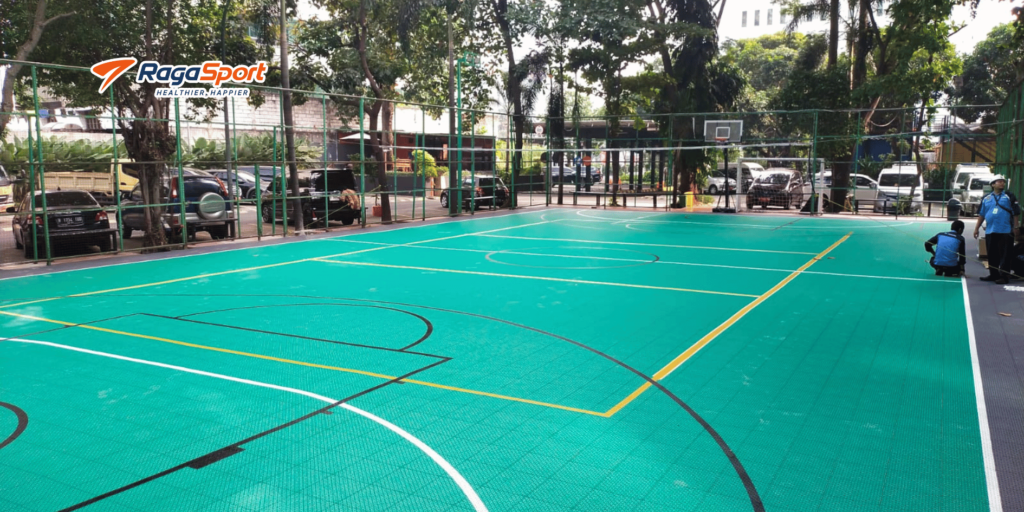
A futsal court in schools or clubs is more than just a supplementary facility. Its presence offers many benefits, including:
- Encourages regular exercise, improving students’ fitness, coordination, and overall health.
- Facilitates PE classes, extracurricular activities, and organized competitions.
- Futsal courts require relatively compact areas, making them suitable for schools with limited land.
- Becomes a hub for school events or club activities, strengthening community interaction.
Build an Ideal School Futsal Court with Ragasport
Building a futsal court for schools and clubs requires more than just available land, it demands careful planning, the right material selection, and professional execution to ensure safety, durability, and optimal play. With a structured futsal court installation approach, every detail, from foundation to finishing, must meet high standards to support long-term use in educational environments.
Ragasport is here as a trusted partner for schools and clubs looking to develop high-quality futsal facilities. With extensive experience handling projects across educational institutions, government facilities, public spaces, and private courts, Ragasport delivers results that combine performance, safety, and durability.
Why choose Ragasport?
- Designs aligned with national and international standards
- Certified by recognized international sports organizations
- Uses premium, long-lasting materials
- Professional and well-managed construction process
- Project warranty and reliable after-sales service
- Flexible and easy payment options
With a strong commitment to quality and client satisfaction, Ragasport ensures every project is executed to the highest standard. Get in touch today to consult your project and start building a futsal court that truly meets your school or club’s needs.