
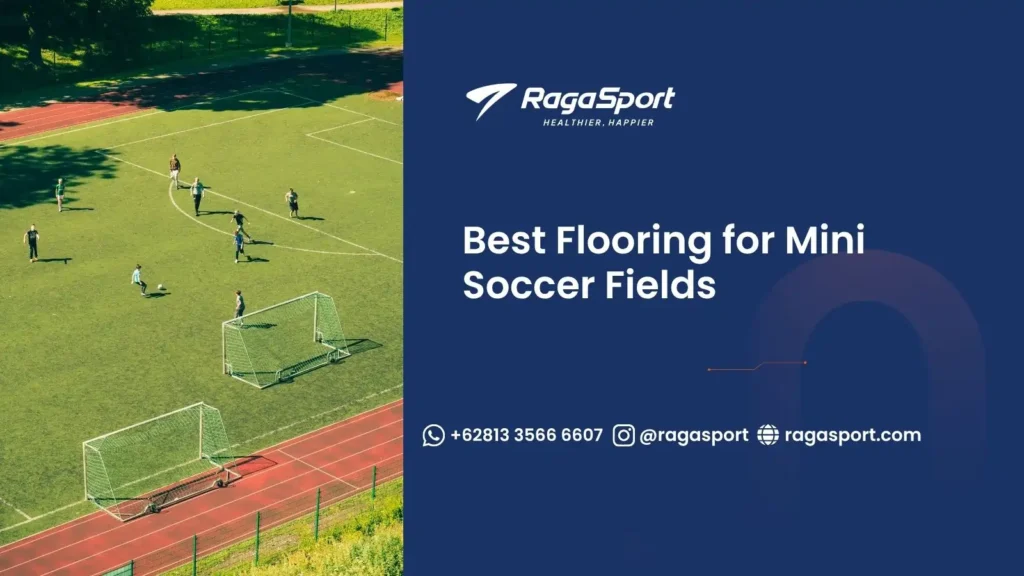
For most projects, the best flooring for mini soccer fields is high-quality 3G synthetic turf installed over a properly engineered base, with the right infill system and, where usage is heavy, a shock pad. That recommendation is not just about aesthetics. It is about matching football movement, reducing downtime after rain, handling repeated weekly use, and staying close to the performance logic behind FIFA’s football turf standards for grassroots and training environments.
The only time 3G turf is not the best answer is when your field is not really football-first, such as an indoor multi-sport venue or a very low-use backyard court. For commercial operators, schools, and community facilities, though, 3G turf is still the most reliable overall choice.
Mini soccer also needs to be separated from formal minifootball standards. Official EMF/WMF rules use a rectangular pitch with a length of 44–50 metres, a width of 24–30 metres, and 4 x 2 metre goals, while many commercial “mini soccer” builds in schools, residential compounds, and private sports centres are commonly smaller, often around 20 x 40 to 30 x 50 metres.
That matters because smaller-sided fields concentrate wear in turning zones, goalmouths, and central channels, so the flooring system has to cope with intense repetitive traffic rather than just total area.
Table of Contents
Why 3G Synthetic Turf Is the Best Flooring for Most Mini Soccer Fields
FIFA’s own football turf framework makes the key point: unfilled or sand-filled systems were long debated for football use, and it was third-generation systems with sand and rubber infill that became the true alternative for the sport. On top of that, FIFA Quality certification is aimed at recreational, training, and grassroots pitches and is designed around surfaces that can typically accommodate 40–60 hours of play per week. That is exactly the use profile many mini soccer businesses, school fields, and community venues are chasing.
From a contractor’s perspective, 3G turf works because it balances four things better than most alternatives:
- football-like ball roll and player movement
- better all-weather usability than natural grass
- lower routine maintenance than living turf
- stronger long-term operating value for high-use facilities
That does not mean every synthetic turf system is equally good. Poor fiber quality, weak seam work, low-density yarn, or a bad sub-base can turn a “good-looking field” into a field that feels flat, runs too fast, drains badly, or wears out early. In other words, the best flooring is not just the top layer. It is the full system.
When Another Flooring Option Can Make Sense
Natural grass can still be a valid choice if you have abundant land, lower booking intensity, an irrigation plan, and a real maintenance team. But for most mini soccer operators, natural grass is harder to justify because it needs mowing, watering, fertilising, recovery time, and more weather management. That is fine for a club with grounds staff. It is much less fine for a pay-to-play venue that needs reliable daily bookings.
Rubber flooring, modular tiles, or other hard-court systems make more sense when the facility is actually futsal, training-focused, or multi-sport. They can be useful for compact indoor venues or recreational spaces, but they do not usually deliver the football feel most users expect from a mini soccer field. If your target customer says “I want a football experience,” hard-court flooring is usually solving the wrong problem.
A more interesting detail in the current market is that FIFA’s updated framework acknowledges mineral-infill stabilised, mineral-infill filled, and non-filled systems as emerging directions, but also states they still require further testing and approval before they can be certified under FIFA Quality or FIFA Quality Pro. So if you want a proven football-first system today, conventional high-quality 3G remains the safer decision.
The Specs That Matter More Than Brand Names
Ask three practical questions before approving a turf system.
1. What usage level is the field expected to handle?
If the venue is a commercial mini soccer business, school, or community field with frequent bookings, think in weekly hours, not just opening day appearance. FIFA Quality’s 40–60 hour-per-week benchmark is a useful reference point for this conversation.
2. Is the turf profile suitable for small-sided football?
Broadly, 3G football systems are commonly built in the 35–65 mm range, while practical guidance for mini soccer and 5-a-side often leans shorter than full-size stadium-style systems. Commercial guidance commonly places mini soccer around 30–50 mm, and some football-first school specifications use either a 60 mm monofilament surface on a suitable base or around a 40 mm surface over a shock pad. The point is simple: do not copy a full-stadium spec blindly. Small-sided football needs control, comfort, and durability in tight-turn areas.
3. Is the base and cushioning right for the site?
The turf carpet gets the attention, but the base build-up decides drainage, stability, and how the surface feels under load. On higher-use mini soccer fields, shock absorption becomes a serious business issue, not a luxury extra. If users complain about hard landings or fatigue, your flooring spec was probably too thin, too rigid, or too value-engineered. This is where site drainage, base tolerance, and optional shock pad design need to be reviewed together, not separately.
The Most Common Flooring Mistakes on Mini Soccer Projects
The first mistake is choosing by price per square metre alone. Cheap turf can look acceptable in photos but fail where it matters: seam strength, infill retention, resilience, and wear pattern.
The second mistake is underestimating maintenance. FIFA’s 2024 football turf requirements are very clear that a certified field should have the required maintenance setup on site, including at least a tractor unit, drag brush or drag mat, top-up infill, a maintenance log, and a ball-roll ramp, unless a proper maintenance contract is in place. Synthetic turf is lower maintenance than natural grass, but it is not maintenance-free.
The third mistake is budgeting only for installation and ignoring resurfacing. A safer commercial assumption is to plan for resurfacing around year eight, depending on usage intensity and maintenance quality. Industry guidance from established turf providers commonly places synthetic field life around 8–10 years, with proper use and maintenance being the deciding factors.
Our Recommendation by Project Type
Choose 3G synthetic turf if you are building:
- a commercial mini soccer venue
- a school or campus football field
- a residential or developer amenity field
- a community pitch with outdoor, all-weather use
- a facility where football is the main product
Choose natural grass only if you have:
- lower usage intensity
- irrigation and groundskeeping capacity
- enough downtime for recovery
- a project brief that prioritises living turf over operating efficiency
Choose modular or hard-court flooring only if:
- the venue is really futsal or multi-sport
- the user expectation is not football-like turf play
- installation speed and multi-use flexibility matter more than football feel
Final Take
If your question is purely “What is the best flooring for mini soccer fields?”, the answer for most real-world projects is high-quality 3G synthetic turf with a proper base, appropriate infill, and a maintenance plan that matches the booking load. That combination gives the best balance of playability, durability, drainage, and commercial practicality. The bigger decision is not whether to use turf. It is whether the turf system, cushioning, and construction method fit your users, climate, and revenue model. If you are planning a new field or upgrading an old one, discuss your project with the RagaSport team to match the right flooring system to your facility goals.
FAQ
Is artificial turf better than natural grass for mini soccer fields?
For most commercial, school, and community mini soccer projects, yes. Artificial turf is usually the better operational choice because it supports heavier use, faster recovery after rain, and lower routine maintenance than natural grass.
What pile height is best for mini soccer turf?
There is no one-size-fits-all number, but mini soccer commonly sits below full-stadium football turf heights. Practical guidance often places mini soccer around 30–50 mm, while broader 3G football systems typically run about 35–65 mm depending on system design.
Do mini soccer fields need a shock pad?
Not always, but high-use fields often benefit from one. A shock pad can improve cushioning and help the surface meet target performance levels, especially where player comfort and repetitive use are priorities.
How long does mini soccer turf usually last?
A realistic planning assumption is around 8 years, with some systems lasting longer depending on product quality, usage, and maintenance discipline.
Is synthetic turf really low maintenance?
It is lower maintenance, not no maintenance. Brushing, infill top-up, inspection, cleaning, and performance checks still matter if you want the field to play consistently and last.