
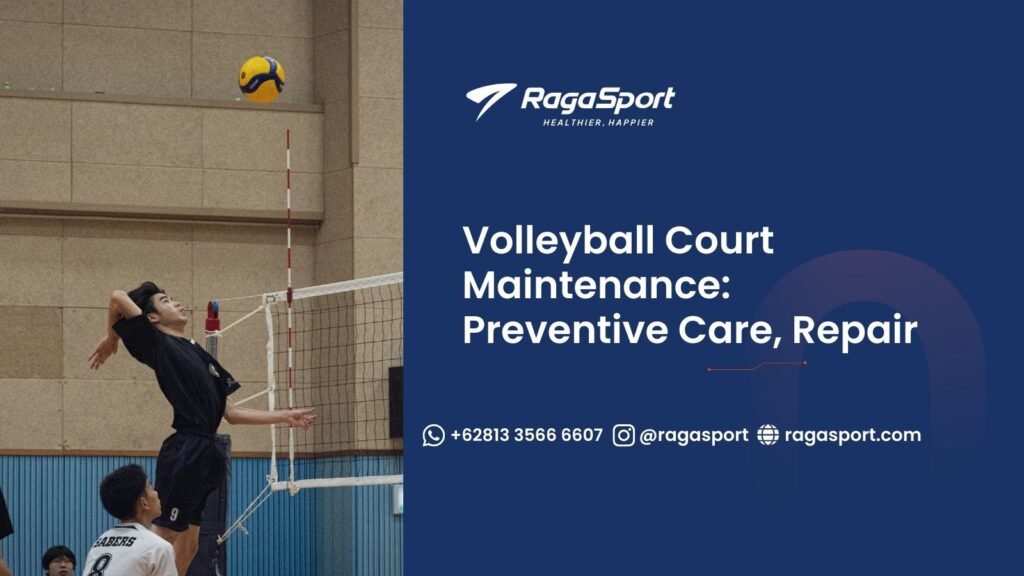
A well-maintained volleyball court does more than look clean — it protects athletes, preserves traction, and extends the life of your surface investment. Whether your court is hardwood, synthetic, outdoor acrylic, modular tile, or sand, each material responds differently to moisture, friction, and cleaning chemicals. Treating them the same is one of the most common and costly mistakes facility owners make.
If your court feels slippery after cleaning, shows early surface wear, or requires frequent repairs, the issue is usually not heavy usage — it is improper maintenance strategy. From humidity control in indoor gyms to drainage management on outdoor courts and proper sand depth in beach volleyball setups, small operational decisions determine whether your court lasts 8 years or 20.
This guide breaks down what truly matters in volleyball court maintenance — practical standards, preventive schedules, and clear indicators of when maintenance is enough and when resurfacing is necessary. If you manage a sports facility or plan to build one, understanding these fundamentals will help you protect both performance and long-term value.
Volleyball Court Maintenance Fundamentals: What Actually Impacts Safety & Lifespan
If maintenance is not just cleaning, then what actually determines whether a volleyball court stays safe and lasts long?
There are three fundamentals that directly impact both athlete safety and surface lifespan — and almost every maintenance issue traces back to one of them.
1. Traction Consistency (Not Just “Cleanliness”)
A court can look spotless and still be dangerous.
Slip resistance changes when:
- Dust builds up and acts like micro-abrasive powder
- Cleaning chemicals leave residue
- Finish layers begin to wear thin
- Outdoor algae or moisture reduces grip
What matters is not shine — it is consistent friction performance. When traction drops, athletes compensate unconsciously: shorter strides, unstable landings, hesitation on cuts. Over time, that increases ankle, knee, and muscle injury risk.
Ask yourself:
- Does the floor feel slightly different near entry doors?
- Does it feel more slippery after cleaning?
- Are players wiping their shoes more than usual?
Those are early signals, not minor inconveniences.
2. Moisture & Environmental Control
Moisture is the silent enemy of every volleyball court.
For indoor hardwood courts, unstable humidity causes expansion and contraction cycles. That leads to:
- Gaps
- Cupping
- Finish stress
- Long-term structural distortion
For outdoor courts, standing water weakens coatings and accelerates surface breakdown.
For synthetic flooring, trapped moisture under the surface can lead to adhesion failure and seam lifting.
This is why humidity control (typically around 35–50% RH for hardwood environments), proper drainage systems, and immediate spill management are not optional — they are structural protection strategies.
Maintenance is climate management as much as it is cleaning.
3. Surface Integrity & Micro-Damage Prevention
Damage rarely starts big.
It starts with:
- A loose seam
- A slightly lifted tile corner
- A minor crack in acrylic coating
- Uneven sand depth under high-traffic zones
- Finish wear just beginning to expose raw wood
When small issues are ignored, they compound. And once structural integrity is compromised, no amount of cleaning will fix it.
The real goal of maintenance is early detection.
Think of it this way:
Would you rather replace one modular tile — or resurface the entire court?
The Big Insight Most Facilities Miss
Heavy usage does not destroy courts.
Poor preventive maintenance does.
High-performance volleyball courts are engineered to handle impact. What they are not engineered to handle is neglect — residue buildup, unmanaged moisture, wrong chemicals, delayed repairs.
So before thinking about resurfacing or renovation, ask:
- Is traction being monitored or just assumed?
- Is humidity measured or guessed?
- Are inspections scheduled or reactive?
If you can confidently answer those questions, you are not just maintaining a volleyball court — you are protecting a long-term sports asset.
Next, let’s break down how maintenance differs depending on your specific court surface — because hardwood, vinyl, outdoor acrylic, and sand do not play by the same rules.
Surface-Specific Maintenance (Indoor Hardwood vs Vinyl vs Outdoor vs Sand)
Not all volleyball courts age the same way.
The biggest maintenance mistake facilities make is applying one cleaning routine to every surface. Different materials react differently to friction, moisture, UV exposure, and chemicals. If you want long lifespan and consistent performance, maintenance must match the surface.
Let’s break it down clearly.
1. Indoor Hardwood Courts (Maple Sports Floors)
Hardwood is performance-grade — but it is sensitive.
What truly matters here:
- Stable humidity (around 35–50% RH) to prevent expansion and contraction
- Daily dust mopping with microfiber to remove abrasive particles
- Immediate spill removal
- Scheduled recoating before finish wear exposes raw wood
What many people miss:
It is not heavy play that damages hardwood — it is dirt acting like sandpaper and unstable indoor climate.
Quick self-check:
- Are there small gaps forming between boards?
- Does the floor feel slightly more slippery near entrances?
- Has the finish lost uniform sheen in high-traffic zones?
If yes, your maintenance system needs adjustment — not just extra cleaning.
2. Vinyl / Synthetic Sports Flooring
Synthetic sports floors are more moisture-tolerant than wood, but they are highly chemical-sensitive.
Best practice:
- Use neutral pH cleaners only
- Avoid solvent-based products
- Perform routine auto-scrubbing in high-traffic venues
- Inspect seams and edges quarterly
The real risk here is residue buildup. When the wrong cleaner leaves film behind, traction drops gradually — and players feel it before you see it.
Ask yourself:
- Does the court feel “sticky” in some areas and slippery in others?
- Are shoe marks accumulating faster than usual?
That’s often a cleaning chemistry issue, not surface failure.
3. Outdoor Acrylic or Modular Courts
Outdoor surfaces face environmental stress more than physical stress.
Maintenance focus:
- Ensure proper drainage after heavy rain
- Remove debris and organic buildup regularly
- Control moss and algae growth
- Inspect surface coating for early cracks
UV exposure slowly degrades coatings. Standing water accelerates it. If drainage is ignored, resurfacing timelines shorten dramatically.
Quick reality check:
After rain, how long does water sit on your court?
If it’s more than a short period, surface lifespan is already being reduced.
4. Sand (Beach Volleyball Courts)
Sand courts are simple — but precision still matters.
Performance depends on:
- Minimum adequate sand depth (typically around 40 cm for competition standards)
- Regular grooming and leveling
- Debris screening
- Anchor and boundary line inspection
Uneven sand depth increases injury risk and affects player movement. The area under the net often compacts faster and requires more frequent leveling.
Look closely:
Is the sand depth consistent across the entire playing area — or is it thinning in high-impact zones?
Small inconsistencies today become safety issues tomorrow.
The Key Insight
Maintenance is not about doing more.
It is about doing the right thing for the right surface.
Hardwood needs climate control.
Vinyl needs chemical discipline.
Outdoor courts need environmental management.
Sand needs leveling and depth control.
If you treat them all the same, performance suffers and lifespan shortens.
So before adjusting your maintenance routine, start with one question:
What surface are you actually protecting?
Because once you understand that, the right maintenance strategy becomes clear — and your court stays safer, longer.
Preventive Maintenance Schedule (Daily–Monthly–Annual Framework)
A volleyball court does not fail suddenly.
It declines gradually — and almost always predictably.
The difference between a court that lasts 18–20 years and one that needs resurfacing in under 10 often comes down to one thing: structured preventive maintenance. Not reactive cleaning. Not occasional deep scrubbing. A system.
Below is a practical framework you can actually implement.
Daily: Protect Traction and Remove Risk Immediately
Daily care is about preventing micro-damage before it accumulates.
Focus on:
- Dust mopping or sweeping to remove abrasive particles
- Immediate spill cleanup
- Quick inspection of seams, edges, lines, and net stability
- Sand raking in high-traffic zones (for beach courts)
Why daily matters:
Fine dust and grit act like sandpaper, especially on hardwood and synthetic surfaces. One week of neglect can accelerate finish wear significantly in high-use facilities.
Quick question for you:
Do you have a daily checklist — or does cleaning depend on who is on shift?
Consistency matters more than intensity.
Weekly: Deep Cleaning and Surface Performance Check
This is where you reset the court.
Depending on surface type:
- Damp mopping or machine scrubbing (synthetic surfaces)
- Inspection of finish wear zones (hardwood)
- Drainage check (outdoor courts)
- Sand leveling across full playing area
Weekly maintenance is about restoring uniformity. If certain zones feel different underfoot — slightly slicker, slightly rougher — this is when you address it.
Ask yourself:
If a player blindfolded walked across your court, would the traction feel consistent everywhere?
If not, your weekly reset needs improvement.
Monthly: Structural Inspection & Early Intervention
Monthly maintenance shifts from cleaning to asset management.
Inspect for:
- Seam lifting or tile movement
- Minor cracks in outdoor coatings
- Finish thinning in high-traffic zones
- Humidity consistency in indoor facilities
- Sand depth measurement across multiple points
This is when small issues are still inexpensive to fix.
A loose seam repaired today costs little.
Ignored for six months, it may require partial resurfacing.
Preventive maintenance is really about catching things before they become budget discussions.
Annual: Professional Evaluation & Lifecycle Planning
Even if your court looks fine, annual evaluation is critical.
This may include:
- Professional traction assessment
- Recoat planning (for hardwood)
- Surface repaint cycle planning (outdoor courts)
- Deep mechanical cleaning
- Drainage system evaluation
Think of it like a medical check-up.
You do not wait for severe pain to see a doctor. You monitor health proactively.
Here’s the bigger perspective:
A volleyball court is not just a surface — it is a long-term facility asset. Annual review ensures maintenance aligns with lifespan expectations and usage intensity.
The Strategic Insight
Maintenance becomes expensive only when it becomes reactive.
If your facility team is constantly “fixing problems,” you do not have a maintenance schedule — you have a damage response system.
So here is the key question:
Is your court maintenance structured… or situational?
If you build discipline into daily, weekly, monthly, and annual routines, your court will not just look better — it will perform consistently, reduce injury risk, and delay major capital expenditure.
And that is what smart volleyball court maintenance really means.
Common Maintenance Mistakes That Shorten Court Lifespan
Most volleyball courts don’t fail because of heavy use.
They fail because of small, repeated mistakes.
And the tricky part? Many of these mistakes look harmless at first. The court still looks fine. Players still train. Games still run. But beneath the surface, wear accelerates quietly.
Let’s break down the most common maintenance errors — and see if any sound familiar.
1. Using the Wrong Cleaning Chemicals
This is the number one silent killer.
Household cleaners, high-alkaline solutions, or solvent-based products may make the surface look shiny — but they can:
- Leave residue that reduces traction
- Break down finish layers
- Weaken seam adhesives (synthetic floors)
- Dry out hardwood coatings
If your court feels more slippery after cleaning, that is not normal. It is a chemical mismatch.
Ask yourself:
Do you know the exact pH and compatibility of the products being used — or are they chosen based on availability?
2. Ignoring Humidity and Environmental Control (Indoor Courts)
Hardwood courts are engineered systems. They respond to climate.
When humidity fluctuates excessively:
- Boards expand and contract
- Gaps appear
- Cupping or warping begins
- Finish layers crack under stress
This damage does not show immediately. It builds over months.
If humidity is not being measured regularly, you are not maintaining the court — you are hoping the climate cooperates.
3. Letting Water Sit (Outdoor Courts)
Water is not just a surface issue. It is a structural one.
Standing water:
- Weakens acrylic coatings
- Seep into cracks
- Encourages moss and algae growth
- Reduces traction
If puddles remain after rain for extended periods, resurfacing timelines will shorten dramatically.
Quick check:
After heavy rain, how long does it take for your court to fully dry?
If you do not know, that is already a risk factor.
4. Skipping Seam and Joint Inspections
Small seam lifting in modular or synthetic floors often gets ignored because it “doesn’t look serious.”
But over time:
- Movement increases
- Adhesion weakens
- Gaps widen
- Trip hazards form
Repairing one loose section is inexpensive. Waiting until multiple sections fail is not.
Preventive maintenance is about micro-repairs, not big renovations.
5. Delaying Recoat or Surface Renewal
For hardwood courts especially, once the protective finish layer wears through, raw wood becomes exposed. At that point, damage accelerates rapidly.
Many facilities wait until the floor “looks bad” before recoating.
By then, the surface may already require sanding instead of simple recoating — a far more expensive process.
The key insight:
Maintenance cycles are time-based, not appearance-based.
6. Treating All Surfaces the Same
Hardwood, vinyl, outdoor acrylic, and sand courts do not respond to stress in the same way.
Using one universal maintenance routine for all surfaces:
- Shortens lifespan
- Reduces performance consistency
- Increases long-term cost
Surface-specific strategy is not optional — it is foundational.
The Bigger Perspective
Most maintenance failures are not dramatic mistakes.
They are patterns of small neglect.
So ask yourself honestly:
- Is your cleaning protocol surface-specific?
- Is humidity monitored or assumed?
- Are inspections scheduled — or reactive?
- Are minor issues documented and tracked?
If maintenance only happens when something feels wrong, lifespan will always be shorter than it should be.
The good news?
Every one of these mistakes is preventable.
And once you eliminate them, your volleyball court does not just last longer — it performs more consistently, reduces injury risk, and protects your investment year after year.
When Maintenance Is Not Enough: Repair vs Resurfacing Decision Guide
Even with the best preventive maintenance system, every volleyball court eventually reaches a turning point.
The real challenge is not whether problems will appear — but knowing when cleaning and minor repairs are still effective, and when resurfacing becomes the smarter decision.
Many facilities either resurface too early (unnecessary capital expense) or wait too long (higher structural damage and safety risk). The key is understanding the signals.
Let’s simplify the decision.
When Maintenance and Minor Repair Are Still Enough
You are likely in the “repair zone” if:
- Traction improves after deep cleaning
- Surface damage is localized (one crack, one lifted seam, one worn area)
- Hardwood finish is thinning but not worn through
- Modular tiles can be individually replaced
- Outdoor coating shows early micro-cracks but no structural failure
In this stage, targeted repair works.
The structure is still intact — you’re just correcting surface-level issues.
Ask yourself:
After cleaning and minor repair, does the court feel performance-consistent again?
If yes, resurfacing may not be necessary yet.
Warning Signs That Maintenance Is No Longer Enough
There is a point where cleaning cannot restore performance.
Consider resurfacing if:
- The floor remains slippery even after proper cleaning
- Hardwood shows exposed raw wood in multiple areas
- Acrylic coating has widespread cracking or peeling
- Surface unevenness affects ball bounce or player stability
- Repeated seam repairs continue to fail
- Drainage issues have caused deeper substrate damage
At this stage, the issue is no longer cosmetic. It is structural.
Here is a simple way to think about it:
If the problem affects surface performance, repair may work.
If it affects structural integrity, resurfacing is likely required.
The Cost Perspective Most Owners Overlook
Delaying resurfacing beyond the right window often increases total cost.
Why?
Because:
- Small cracks widen
- Moisture penetrates deeper layers
- Adhesion weakens
- Subfloor damage begins
Resurfacing at the correct time protects the foundation. Waiting too long may mean full reconstruction rather than surface renewal.
So the smarter question is not:
“How long can we delay resurfacing?”
It is:
“What stage of surface lifecycle are we currently in?”
A Practical Self-Assessment
Walk your court and evaluate:
- Does traction feel uniform across all zones?
- Are high-traffic areas significantly more worn than the rest?
- Does the ball bounce consistently across the entire surface?
- Have you repaired the same issue more than twice in the same spot?
If you answered “yes” to the last question, maintenance may be buying time — not solving the root problem.
The Strategic Insight
Maintenance protects lifespan.
Resurfacing restores performance.
They are not opposites — they are part of the same lifecycle.
Smart facility management means recognizing when your court transitions from preservation mode to renewal mode. Making that decision at the right time protects athlete safety, maintains professional standards, and avoids unnecessary long-term expense.
Because in the end, volleyball court maintenance is not about stretching lifespan indefinitely.
It is about protecting performance at every stage of the court’s life.
Volleyball court maintenance is not about making the surface look clean — it is about protecting performance, safety, and long-term asset value. From traction consistency and humidity control to surface-specific care and timely resurfacing decisions, every stage of maintenance directly impacts how your court performs under real game conditions.
The difference between a court that lasts 20 years and one that deteriorates in half that time is rarely usage intensity. It is strategy. Structured preventive maintenance, early intervention, and clear repair-versus-resurface decisions are what protect both athletes and investment.
So the real question is not whether your court is being cleaned.
It is whether your court is being managed as a high-performance system.
If you are planning to build, upgrade, or evaluate an existing volleyball facility, a professional technical assessment can help you identify risks early, optimize maintenance strategy, and extend surface lifespan efficiently.
At RagaSport, we help facility owners and sport center developers design and maintain volleyball courts that perform consistently — not just today, but for years ahead.
Ready to evaluate your court’s condition or plan your next project?
Let’s start with a proper surface assessment.