
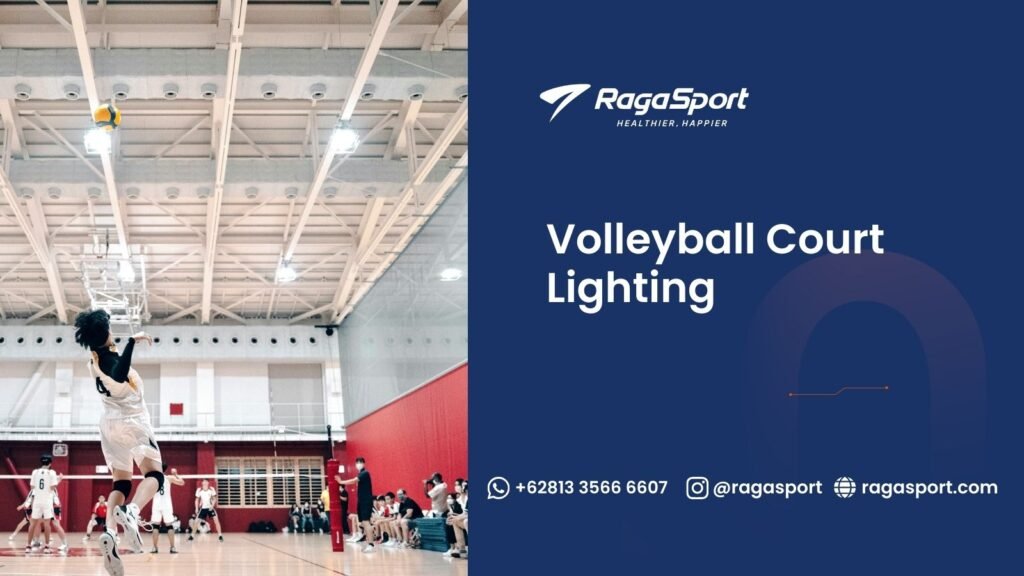
In volleyball, players spend a surprising amount of time looking up. During serves, sets, blocks, and spikes, the eyes constantly follow the ball against the ceiling or night sky. This simple fact is what makes volleyball court lighting fundamentally different from lighting for many other sports. A lighting system that works “well enough” for futsal or basketball can easily become a problem in volleyball—causing glare at the service line, uneven visibility in the backcourt, or delayed ball tracking during fast rallies.
Because of that, designing volleyball court lighting is not just about reaching a certain brightness level. Lux values matter, but they are only the starting point. How the light is measured, how evenly it is distributed across the court, how glare is controlled in upward sightlines, and how shadows are minimized all play a critical role in player performance, safety, and referee accuracy. These factors become even more critical in multi-court sport centers and competition venues, where lighting must work consistently across different match intensities and usage scenarios.
This article breaks down volleyball court lighting from a practical, decision-maker perspective: what lighting levels are actually required, how they should be measured, and how lighting should be designed so it supports the way volleyball is played—not just how the court looks. If you are planning, upgrading, or evaluating a volleyball court, this guide will help you avoid the most common mistakes and make lighting decisions that hold up in real-world use.
Volleyball court lighting standards (lux levels)
Before talking about fixtures, layouts, or budgets, there’s one question every volleyball court project must answer first: how bright does the court actually need to be? This is where many projects go wrong—not because the numbers are unknown, but because they’re misunderstood or applied without context.
In volleyball, lighting standards are tied closely to how the court is used. A training court, a local competition venue, and a broadcast-level arena do not—and should not—share the same lighting target. Designing everything to “feel bright” often leads to glare, wasted energy, or costly retrofits later.
At a high level, international and national guidelines converge on these practical benchmarks:
| Court use | Typical lighting level (lux) | What this means in practice |
|---|---|---|
| Training / recreational | ~200–300 lux | Sufficient for drills and casual play, but not ideal for official matches |
| Local & regional competition | ~300–500 lux | Clear ball visibility and acceptable consistency for competitive play |
| National / professional matches | ~750–1000 lux | Higher visual comfort, better tracking during fast rallies |
| Broadcast / elite events | 1500–2000+ lux | Designed for cameras, slow motion replay, and television standards |
For indoor volleyball, organizations like FIVB and USA Volleyball commonly reference 300 lux measured at 1 meter above the playing surface as a baseline for sanctioned competition, with significantly higher levels required for top-tier and broadcast events. Beach volleyball played at night follows a similar logic but typically demands higher light output due to the open environment and darker surroundings.
However, here’s the part that rarely gets explained clearly: lux is not a single magic number you “hit.” It’s an average measured across a grid, and two courts with the same average lux can feel completely different to players. One might be comfortable and predictable, while the other causes glare during serves or leaves the backcourt visually uneven.
That’s why experienced designers treat lux levels as a starting point, not the finish line. Once the target lux is defined based on the court’s highest intended use, the real work begins—ensuring that light is distributed evenly, glare is controlled, and visibility remains consistent from every position on the court. If you’re planning a volleyball facility, a good rule of thumb is simple: design for the highest level of play you expect, not just today’s usage. It’s far easier to dim lights down than to rebuild a lighting system that was underdesigned from the start.
How volleyball court lighting is measured (height + method)
This is the part most people skip—and the reason many volleyball courts technically look fine but still fail when evaluated properly. Lighting is not judged by how bright the court feels, but by how it performs when measured in a consistent, repeatable way.
First, let’s talk about measurement height, because this is where confusion usually starts. In volleyball, lighting levels are commonly measured 1 meter above the playing surface, not at floor level and not at eye level. This height represents the visual zone where players track the ball during rallies and where officials evaluate play. Both international competition guidelines from FIVB and national standards such as USA Volleyball reference this measurement height when defining compliance for sanctioned matches.
Next is how the measurement is done, not just where. Proper volleyball court lighting is measured using a grid method across the entire playing area. Instead of taking one or two readings in the middle of the court, measurements are taken at multiple evenly spaced points—front court, backcourt, sidelines, and center zones. From these readings, three things are evaluated:
- Average illuminance: the overall brightness level (the lux number most people focus on)
- Minimum illuminance: the darkest points on the court
- Uniformity ratio: how evenly light is distributed from brightest to darkest areas
Here’s why this matters in real play. Two courts can both measure 300 lux on average, but one might have bright hotspots near the net and darker backcourt zones, while the other feels visually consistent everywhere. Players will always prefer the second court—even though the average lux is identical. This is especially critical in volleyball, where serve reception and defensive play happen deep in the backcourt under upward sightlines.
Timing also matters. Measurements should be taken after fixtures are aimed and fully warmed up, and for outdoor or beach volleyball courts, always at night under actual operating conditions. Measuring too early, or under partial lighting, often produces numbers that don’t reflect real match conditions.
If you’re evaluating an existing court or commissioning a new one, a simple question helps cut through the noise: Are we measuring this court the way players actually experience it during play? If the answer is yes—correct height, full grid, proper conditions—you’re already ahead of most projects. If not, the lux number on paper won’t tell you much about how the court will perform once the first serve goes up.
Uniformity and glare control (lux is not enough)
Once lux levels are defined and measured correctly, many projects assume the job is done. In volleyball, this is exactly where problems usually begin. A court can meet the required lux standard and still perform poorly if uniformity and glare are not controlled. Players feel it immediately—even if the numbers on paper look “correct.”
Uniformity is about how evenly light is spread across the court. Volleyball demands high visual consistency because play constantly shifts between the front court and the backcourt, and players repeatedly transition from looking forward to looking upward. If one area is noticeably darker, the brain needs extra time to adapt, and that split second matters during fast rallies. From a design perspective, uniformity is often more important to perceived quality than simply increasing brightness.
This is why professional guidelines—such as those referenced by FIVB—emphasize not only average illuminance but also minimum values and distribution. Courts with poor uniformity often show the same pattern: bright zones near the net, darker corners in the backcourt, and inconsistent visibility along the sidelines. Players don’t describe this as “low lux”; they describe it as hard to read the ball.
Then there’s glare, which is arguably the biggest lighting issue in volleyball. Servers, setters, and hitters regularly track the ball against the ceiling or sky. If luminaires are placed directly within these upward sightlines, even high-quality LED fixtures can become a visual distraction. Glare doesn’t just reduce comfort—it affects accuracy, timing, and confidence. A player hesitating during a serve or mistiming a block is often reacting to visual interference, not a technical mistake.
Good glare control comes from design choices, not higher wattage:
- Proper fixture placement outside critical sightlines
- Optics that shape light onto the court, not into players’ eyes
- Consistent aiming and shielding, especially near service zones
An important insight many facilities miss: adding more light rarely fixes glare or uniformity problems. In fact, it often makes them worse. A slightly lower lux level with excellent uniformity and controlled glare will almost always outperform a brighter but poorly designed system.
If you want a quick reality check, ask this during a site walk: Can players look up comfortably from every serve position without squinting or losing the ball? If the answer isn’t a clear yes, the issue isn’t lux—it’s uniformity and glare control.
Indoor volleyball court lighting design (fixture type & placement)
After standards, measurement, uniformity, and glare, this is where everything comes together—or falls apart. Indoor volleyball court lighting design is not about choosing the “brightest” fixture, but about choosing the right type of fixture and placing it where it supports the way volleyball is actually played.
Let’s start with fixture type. In most indoor volleyball venues, lighting falls into two categories: LED high-bay luminaires and LED sports floodlights. High-bays are commonly used in gyms with moderate ceiling heights and are effective when paired with proper optics that spread light evenly across the full court width. Floodlights, on the other hand, are more suitable for large halls or arenas with higher ceilings, where precise aiming is needed to control glare and reach longer distances. The wrong choice here usually leads to either patchy lighting or excessive glare—sometimes both.
Placement matters even more than the fixture itself. Volleyball is unique because players frequently look upward from fixed positions, especially during serves and sets. That means luminaires should never be placed directly above or in front of primary sightlines, such as service zones or typical ball trajectories near the net. A layout that looks symmetrical on a drawing can still be uncomfortable on court if fixtures sit exactly where players track the ball.
Well-designed indoor courts follow a few practical principles:
- Fixtures are positioned outside critical upward sightlines, not directly above center court
- Light is aimed to overlap smoothly across the playing area, reducing bright spots near the net
- Backcourt zones receive the same visual priority as the front court, not treated as secondary areas
Ceiling height plays a decisive role here. Lower ceilings require wider beam optics and tighter spacing to maintain uniformity, while higher ceilings allow for narrower beams but demand more careful aiming to avoid glare. This is also where many retrofits fail—new LED fixtures are installed using the old layout from metal halide systems, even though LEDs behave very differently optically.
Modern indoor volleyball lighting designs increasingly use scene-based control as well. Training sessions, competitive matches, and events do not need identical lighting conditions. Designing for the highest level of play and then dimming down for daily use is far more effective than installing a system that barely meets minimum requirements with no flexibility.
A simple way to evaluate an indoor layout before installation is to ask: From the service line, can a player track the ball upward without seeing the light source directly? If the answer is yes across all service positions, the fixture type and placement are likely working together—not against the game.
Outdoor / beach volleyball lighting basics
Outdoor and beach volleyball lighting plays by a different set of rules. Once you remove the ceiling and walls, dark surroundings, weather exposure, and long sightlines suddenly become part of the equation. A lighting setup that works perfectly indoors can fail badly outdoors—even if the lux number looks impressive on paper.
The first key difference is environmental contrast. At night, beach volleyball courts are surrounded by near-total darkness, which means players’ eyes adapt very differently compared to indoor halls. This is why outdoor and beach volleyball—especially at competition level—typically requires higher effective lighting levels and much stricter glare control. Guidelines referenced by bodies such as FIVB reflect this by recommending significantly higher lux targets for official night play than for basic recreational use.
Next comes pole layout and aiming, which is the backbone of outdoor lighting design. Unlike indoor courts, where fixtures can be distributed evenly above the playing area, outdoor courts rely on perimeter-mounted poles. Poor pole placement often leads to two classic problems: harsh glare when players look up to serve, and uneven lighting between the center and corners of the court. Good designs place poles far enough from the sidelines and use cross-aiming techniques so light overlaps smoothly across the sand, instead of blasting straight down from one direction.
Weather resistance is not optional—it’s fundamental. Beach environments are especially aggressive: salt air, wind, humidity, and sand all shorten the lifespan of poorly specified fixtures. Outdoor volleyball lighting should always consider:
- High ingress protection (dust and water)
- Corrosion-resistant materials
- Wind-load-rated poles and mounts
- Surge protection for open-area installations
Another often-overlooked factor is light spill and surroundings. Outdoor courts are frequently located near residential areas, resorts, or public spaces. A good lighting design keeps light on the court—where it’s needed—and minimizes spill into the environment. This isn’t just about regulations; it directly affects community acceptance and long-term operation.
A simple reality check for outdoor or beach courts is this: Can players clearly track a high ball against the night sky without being distracted by glare or harsh contrast? If the answer is yes, the lighting is doing its job. If not, the issue is rarely about adding more fixtures—it’s about better placement, better optics, and designing for the realities of playing volleyball outdoors.
LED specification checklist (buyer-focused)
Once lux targets and layouts are defined, the final outcome of a volleyball court lighting system is decided by the LED fixture specifications. This is where many projects fail—not because the design is wrong, but because the fixtures chosen cannot deliver the design intent in real play.
Below is a numbered checklist that buyers should actually use when selecting LED lighting for volleyball courts.
1. Optical control & glare management
Volleyball involves frequent upward sightlines, so optics matter more than raw output.
- Look for dedicated sports optics, not generic wide-beam LEDs
- Controlled beam angles help keep light on the court, not in players’ eyes
- Optional glare shields or visors are a strong indicator of sport-specific design
If glare control is unclear in the spec sheet, assume it will be felt on court.
2. Flicker-free driver performance
Flicker affects comfort, timing, and any form of video recording.
- Use fixtures with documented low-flicker or flicker-free drivers
- This is critical for venues that stream, record, or host events
- “Flicker-free” should be measurable, not just a marketing label
A court can meet lux standards and still feel uncomfortable if flicker is present.
3. Photometric data (IES / LDT files)
No photometric data = no real design validation.
- Always request IES or LDT files
- These files allow accurate lighting simulations before installation
- Proper simulations reduce re-aiming, rework, and post-installation complaints
If simulations can’t be shown, the lighting performance is essentially unverified.
4. Efficiency & thermal management
High lumen output is meaningless without thermal stability.
- Efficient LEDs maintain output over time, not just on day one
- Poor heat dissipation leads to lumen drop and color shift
- Thermal design is especially important in high-ceiling indoor halls
This directly affects long-term uniformity and maintenance cost.
5. Durability & protection level
Volleyball courts are active environments.
- Indoor courts still require protection from dust, vibration, and ball impact
- Outdoor and beach courts need corrosion resistance and surge protection
- Choose fixtures rated for the actual environment, not just the location
Durability is part of performance, not a separate concern.
6. Warranty & long-term support
Lighting is a long-term infrastructure decision.
- Look for clear warranty terms on LEDs and drivers
- Confirm availability of spare parts and technical support
- A strong warranty reflects confidence in real-world performance
A lower upfront price rarely compensates for poor after-sales support.
Volleyball court lighting is successful not when it simply meets a lux requirement, but when it supports how the game is played—from upward ball tracking and fast rallies to consistent visibility across every zone of the court. As we’ve seen, real performance comes from getting the fundamentals right: setting the correct lux target based on usage, measuring lighting properly, prioritizing uniformity and glare control, choosing the right fixture type and placement, and specifying LEDs that are built for sports environments, not just for brightness.
If there’s one takeaway, it’s this: most lighting problems are not caused by lack of light, but by poor design decisions early in the project. Once a system is installed, fixing glare, uneven distribution, or underperformance is far more expensive than getting it right from the start. Whether you’re planning a new indoor hall, upgrading an existing gym, or developing an outdoor or beach volleyball venue, lighting should be treated as a performance system—not an afterthought.
If you’re planning or upgrading a volleyball court and want a lighting design that meets standards and feels right in real play, talk to a specialist who understands sports lighting from a performance perspective. RagaSport can help you define the right lux targets, layout, and LED specifications—so your court works as intended on day one and years down the line.