
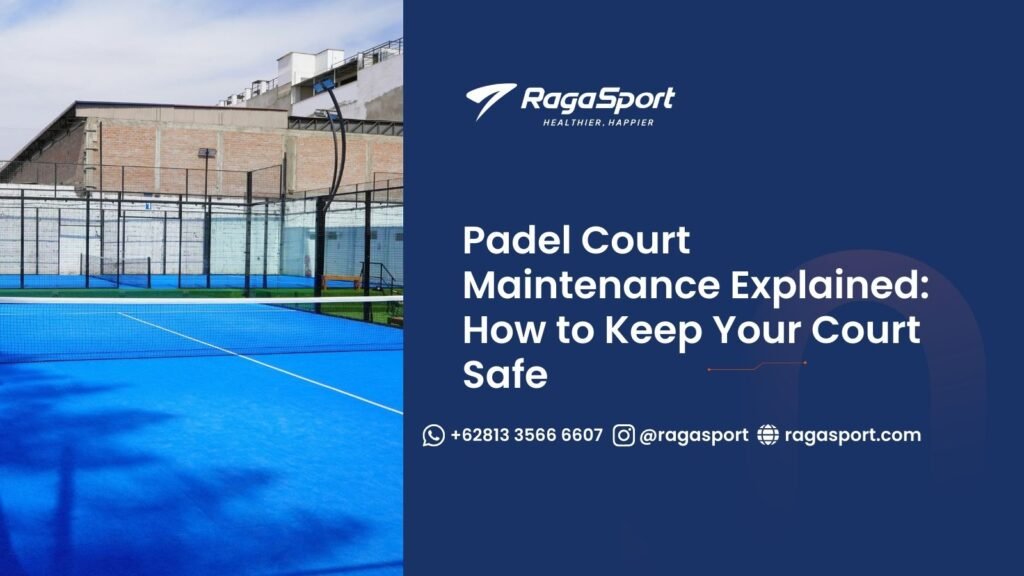
A padel court can look fine — until performance starts dropping. Uneven ball bounce, slippery turf, loose sand near the back glass, or small cracks in the structure often begin as minor issues. Without proper padel court maintenance, those small issues quickly turn into safety risks and costly repairs.
So the real question is simple: are you maintaining your court proactively, or reacting when problems appear?
In this guide, we break down exactly what padel court maintenance involves — from turf brushing and sand redistribution to glass cleaning and structural inspections — so your court stays safe, consistent, and built to last.
The Complete Padel Court Maintenance Schedule (Daily, Weekly, Monthly, Annual)
If you want your padel court to stay safe, consistent, and profitable, maintenance cannot be random. It needs structure. The good news? It doesn’t have to be complicated. What matters is consistency and knowing what to check — and when.
Let’s break it down into a practical, real-world schedule you can actually implement.
Daily Maintenance (After Heavy Use or End of Day)
Think of this as performance protection.
• Remove leaves, dust, and loose debris using a soft blower or brush
• Inspect high-traffic areas (baseline and near the net)
• Check for visible sand displacement
• Quick visual check on glass panels and net tension
Why daily matters: organic debris traps moisture. In humid climates, that accelerates algae growth and creates slippery zones. A 10-minute routine can prevent a major cleaning job later.
Ask yourself:
Did today’s matches leave sand piled against the back glass? If yes, it needs redistribution tomorrow — not next week.
Weekly Maintenance (Surface Performance Focus)
This is where most courts fail.
• Brush artificial turf to keep fibers upright
• Redistribute sand infill evenly
• Inspect seams and line markings
• Clean glass with non-abrasive solution
• Check gate hinges and locking mechanisms
Artificial turf compacts under repetitive play. When sand compacts, ball bounce becomes inconsistent and player injuries become more likely. Weekly brushing restores elasticity and keeps the surface responsive.
If your court hosts tournaments or high daily bookings, this may need to be done twice per week.
Monthly Maintenance (Structural & Drainage Control)
Now we shift from surface to system.
• Inspect drainage channels and perimeter areas
• Check for early rust signs on steel joints
• Tighten visible bolts and fasteners
• Inspect fence alignment
• Evaluate lighting cleanliness and stability
Water pooling is often the first warning sign of poor drainage. If water remains longer than expected after rain, your sub-base or channel system needs attention.
Structural inspections at this stage prevent long-term repair costs. A loose bolt today can become a cracked panel tomorrow.
Annual Maintenance (Professional-Level Servicing)
At least once per year — ideally before peak season — schedule a deeper inspection.
• Professional deep brushing and decompaction
• Sand level measurement and top-up
• Detailed glass panel integrity check
• Structural load and anchoring inspection
• Moss/algae treatment (for outdoor courts)
• Lighting system testing
This is not just cleaning. It’s performance calibration.
Professional servicing can extend turf lifespan by several years and significantly reduce the risk of premature resurfacing — which is far more expensive than preventive maintenance.
Climate-Based Adjustments (Important Insight)
Maintenance frequency depends on:
• Humidity level
• Rain exposure
• Booking intensity
• Indoor vs outdoor environment
In tropical regions, algae control may need bi-monthly treatment.
In high-usage commercial sport centers, weekly brushing becomes non-negotiable.
There is no “one-size-fits-all” schedule. There is only smart adaptation.
Quick Reality Check
If you manage a padel facility, ask yourself:
• When was the last time sand levels were measured, not just eyeballed?
• Are you logging maintenance activity, or relying on memory?
• Would your court pass a safety inspection today?
A structured maintenance schedule doesn’t just protect the court. It protects your reputation.
Because in padel, performance consistency is everything — and maintenance is what makes it possible.
Artificial Turf & Sand Infill Maintenance (The #1 Performance Factor)
If there’s one area you should never ignore in padel court maintenance, it’s the artificial turf and sand infill. This is where performance lives. Ball bounce, player grip, sliding control, and even injury risk are directly influenced by how well the surface is maintained.
A padel court doesn’t “wear out” overnight. It slowly loses performance. The fibers begin to lean. The sand compacts. High-traffic areas near the baseline lose infill. The back-glass zone collects displaced sand. Players may not complain immediately — but they will feel it.
Let’s break down what actually matters.
1. Brushing: The Most Underrated Task
Brushing is not cosmetic. It restores fiber orientation and redistributes sand evenly across the surface.
When turf fibers stay flattened:
- Ball rebound becomes inconsistent
- Player traction decreases
- Surface drainage weakens
- Turf lifespan shortens
Best practice:
- Use a specialized brush or drag mat designed for synthetic turf
- Brush in multiple directions, not just one
- Focus on high-use areas (baseline, service box, near net)
High-usage commercial courts should brush at least once per week. Heavy booking schedules may require twice weekly brushing.
Quick check:
Run your hand across the turf. Does it feel flat and dense? That’s compaction starting.
2. Sand Infill: Performance Stabilizer
Silica sand is not filler — it’s structural support.
Proper sand levels:
- Keep fibers upright
- Absorb impact
- Maintain predictable ball bounce
- Protect turf backing
Over time, sand moves. It shifts toward the back glass. It collects near edges. Wind and heavy play accelerate displacement.
Signs you need redistribution or top-up:
- Visible fiber exposure
- Sand piling near glass panels
- Faster-than-usual ball speed
- Uneven bounce patterns
In professional-level facilities, sand levels are measured periodically — not guessed. Maintaining optimal infill depth can extend turf lifespan by years.
3. Compaction & Decompaction
In high-traffic courts, sand compacts and loses its shock-absorbing quality.
Compacted sand:
- Hardens the surface
- Increases joint stress for players
- Reduces drainage efficiency
Deep brushing or mechanical decompaction (annually or bi-annually) helps restore surface elasticity.
Think of it like aerating a football field — except on synthetic turf.
4. Moisture, Algae & Surface Safety
In humid climates, neglected sand and organic debris create the perfect environment for algae and moss.
Warning signs:
- Slightly darker surface patches
- Slippery feeling after rain
- Greenish buildup near edges
Prevention strategy:
- Keep debris removal consistent
- Ensure proper drainage
- Apply controlled treatment when necessary
Slippery turf is not just a maintenance issue — it’s a liability issue.
5. When Turf Needs Professional Attention
Even with routine maintenance, turf has limits.
Call for professional servicing when:
- Fibers remain flat after brushing
- Sand cannot be redistributed evenly
- Seams begin to separate
- Drainage issues persist
Ignoring early signs often leads to premature resurfacing — one of the biggest avoidable expenses in padel facility management.
Quick Self-Assessment
Ask yourself honestly:
- Is the ball bounce consistent from baseline to net?
- Do players ever mention “hard” or “fast” areas?
- When was the last time sand levels were properly checked?
Artificial turf and sand infill are not background elements. They are the engine of your padel court’s performance.
Maintain them well — and everything else becomes easier.
Glass Panels & Structural Safety Inspections
A padel court can survive minor turf imperfections.
It cannot afford structural failure.
Glass panels and steel structures are not decorative elements — they are load-bearing components designed to absorb ball impact, player contact, and environmental stress. When neglected, they become the highest safety risk in the entire facility.
So let’s talk about what actually matters.
1. Glass Panels: More Than Just Visibility
Tempered glass in padel courts is engineered for impact, but it is not invincible. Micro-cracks, edge chips, and mounting stress often begin invisibly.
What to inspect regularly:
• Hairline cracks near bolt holes
• Chips along panel edges
• Movement or vibration when impacted
• Uneven panel alignment
• Clouding caused by improper cleaning chemicals
Important insight:
Most structural glass failures start at stress concentration points — usually near anchors or edges. A small chip today can expand under repeated impact and temperature shifts.
Quick check:
After a busy match day, lightly press the glass panel. Does it feel solid and stable? Or slightly loose?
If it moves, the mounting system needs inspection immediately.
2. Cleaning Without Damaging
Glass maintenance is not about shining — it’s about protection.
Avoid:
• Abrasive sponges
• Strong chemical solvents
• Metal scrapers
Use:
• Soft microfiber cloth
• Neutral, non-abrasive glass cleaner
• Clean water rinse
In coastal or humid regions, salt and moisture can accelerate corrosion around fittings. Regular cleaning reduces long-term structural stress.
3. Steel Structure & Fasteners: The Silent Risk
Steel frames carry the entire structural load of the court.
Monthly inspection should include:
• Bolt tightness
• Early rust detection
• Weld condition checks
• Fence stability
• Gate alignment
Rust is rarely cosmetic. It weakens structural integrity over time. Early treatment prevents expensive reinforcement later.
Advanced insight:
In high-humidity environments, corrosion begins internally before visible surface rust appears. Proactive anti-corrosion treatment significantly extends structural lifespan.
4. Impact Stress & Repetition Fatigue
Padel is impact-heavy. Balls repeatedly strike glass. Players push off fences. Wind pressure affects outdoor courts.
Over time, stress accumulates.
Watch for:
• Rattling sounds during impact
• Slight misalignment between panels
• Anchor base movement
• Increased vibration
These are early warning signals — not minor inconveniences.
5. When to Escalate to Professional Inspection
Call a professional if:
• You notice any visible crack progression
• A panel shifts from its original position
• Multiple bolts require repeated tightening
• The fence leans or loses tension
• Severe storms recently hit your area
Structural issues rarely improve on their own. Early intervention costs far less than glass replacement or structural repair.
Quick Safety Reflection
Ask yourself:
• Would you feel confident hosting a tournament on this court tomorrow?
• Has every bolt been checked in the past 30 days?
• If a player dives into the glass, are you certain it’s secure?
Glass panels and structural components are where maintenance shifts from performance to responsibility.
Protecting your court means protecting your players.
Common Maintenance Problems & How to Fix Them
Even with a solid maintenance schedule, issues can still appear. The key difference between a well-managed padel facility and a struggling one is not the absence of problems — it’s how quickly they’re diagnosed and corrected.
Let’s go through the most common padel court maintenance problems and what you should actually do when they show up.
1. Uneven Ball Bounce
What you notice:
Players complain that the ball feels “faster” or “dead” in certain areas.
Most likely cause:
Compacted sand infill or uneven sand distribution.
What to do:
• Brush the turf in multiple directions
• Redistribute sand from edges and back-glass areas
• Measure infill depth if inconsistency continues
If brushing doesn’t restore bounce consistency, deep decompaction may be required.
Quick test: Drop a ball from the same height in multiple spots. If rebound height varies significantly, infill imbalance is likely the issue.
2. Slippery Surface (Especially After Rain)
What you notice:
Players feel reduced grip. Surface feels slightly slick.
Most likely cause:
Organic debris buildup leading to algae or moss formation.
What to do:
• Increase debris removal frequency
• Inspect drainage system
• Apply appropriate surface treatment if needed
In humid or tropical climates, this can escalate quickly. Prevention is far easier than recovery.
Ask yourself: Has debris removal been consistent, or only reactive?
3. Sand Accumulating Near the Back Glass
What you notice:
Visible sand piles forming near the glass panels.
Most likely cause:
Repeated impact and player movement pushing infill backward.
What to do:
• Manually redistribute sand evenly
• Increase brushing frequency in high-impact zones
• Evaluate whether infill levels are too high or uneven
This is common in high-usage courts and should be corrected early to maintain consistent surface balance.
4. Water Pooling After Rain
What you notice:
Water remains on the surface longer than expected.
Most likely cause:
Clogged drainage channels or sub-base compaction issues.
What to do:
• Clear perimeter drains
• Inspect slope and water flow
• Schedule structural evaluation if pooling persists
Persistent pooling can damage turf backing and accelerate structural wear.
If water remains more than 30–60 minutes after moderate rain, drainage inspection is overdue.
5. Loose Bolts or Rattling Glass Panels
What you notice:
Minor vibration sounds during play. Slight panel movement.
Most likely cause:
Fastener loosening due to repeated impact stress.
What to do:
• Tighten visible bolts
• Inspect anchor integrity
• Monitor for recurring loosening
If the same bolt requires tightening repeatedly, deeper structural assessment is needed.
6. Flattened Turf Fibers
What you notice:
Surface looks matted or dense, especially near baseline.
Most likely cause:
High traffic without adequate brushing.
What to do:
• Increase brushing frequency
• Consider mechanical decompaction annually
• Review booking density vs maintenance frequency
Flattened fibers reduce cushioning and shorten turf lifespan.
The Bigger Picture
Most padel court problems are predictable. They follow patterns. They give warning signs.
The real question is not whether issues will appear — they will.
The question is whether you have a system to detect and fix them early.
So take a moment:
• Are bounce patterns consistent across the court?
• Does your surface feel safe under quick directional changes?
• Have you heard any unusual vibration or noise recently?
Maintenance is not just about preserving infrastructure. It’s about protecting performance, safety, and reputation — every single match.
When to Call a Professional Padel Court Maintenance Service
Routine maintenance keeps your court healthy. But there’s a point where brushing, cleaning, and bolt-tightening are no longer enough.
The mistake many facility owners make is waiting until something breaks. Professional maintenance isn’t just for emergencies — it’s for prevention, calibration, and long-term cost control.
Let’s clarify when it’s time to bring in experts.
1. When Surface Performance Doesn’t Improve After Routine Care
If you’ve brushed the turf, redistributed sand, cleaned debris — and:
• Ball bounce still feels inconsistent
• Certain areas feel harder than others
• Players notice “fast” or “dead” spots
This often means deeper sand compaction or infill imbalance that requires mechanical decompaction equipment.
DIY brushing restores the surface layer. Professional servicing restores the structure beneath it.
2. When Drainage Problems Persist
Water pooling that doesn’t resolve after clearing visible drains is a warning sign.
It may indicate:
• Sub-base compaction
• Slope misalignment
• Clogged drainage channels below surface level
Ignoring this can damage turf backing and shorten lifespan significantly.
If water consistently remains after moderate rain, it’s time for inspection — not guesswork.
3. When Structural Components Show Repeated Issues
If you find yourself tightening the same bolt every month, or noticing recurring vibration in glass panels, that’s not a maintenance routine — that’s a pattern.
Professional inspection is necessary when:
• Glass panels shift from original alignment
• Anchor points show stress
• Rust spreads despite surface treatment
• Fence structure feels unstable
Structural stress compounds over time. Early reinforcement prevents major replacement.
4. Before Peak Season or Major Tournaments
Smart operators don’t wait for problems. They schedule preventive servicing before:
• Tournament season
• High-booking periods
• Facility relaunches
• Annual safety reviews
Professional servicing typically includes:
• Deep brushing & sand level measurement
• Structural alignment checks
• Glass integrity inspection
• Drainage evaluation
• Preventive anti-corrosion treatment
This is performance optimization — not damage repair.
5. When Turf Approaches Mid-Life
Artificial turf doesn’t suddenly fail. It gradually loses elasticity.
If your court is several years old and showing:
• Persistent fiber flattening
• Sand instability
• Reduced cushioning
• Visible seam stress
A professional assessment can determine whether restorative servicing can extend lifespan — or whether resurfacing should be planned strategically rather than reactively.
Planning ahead reduces downtime and protects revenue.
The Cost Perspective (Often Overlooked)
Preventive professional maintenance is significantly less expensive than:
• Glass replacement
• Structural reinforcement
• Full turf resurfacing
• Legal liability from injury
The smartest facilities treat professional servicing as part of operating costs — not emergency expenses.
Quick Self-Reflection
Ask yourself honestly:
• Would you feel confident having an independent safety inspector review your court today?
• Has a professional assessed your court in the past 12 months?
• Are you reacting to issues — or staying ahead of them?
A well-maintained padel court is not just cleaned. It is calibrated, inspected, and professionally supported when necessary.
Because in padel facility management, prevention is always more profitable than repair.
Padel court maintenance is not about occasional cleaning — it’s about protecting performance, safety, and long-term investment. From daily debris removal to annual structural inspections, every layer of your court plays a role in delivering consistent bounce, secure footing, and a professional playing experience. The difference between a court that deteriorates quickly and one that performs optimally for years often comes down to structured, proactive care.
If you manage a padel facility, the real question is not whether maintenance is necessary — it’s whether your current system is enough. A well-maintained court builds trust with players, reduces operational risk, and protects revenue. And when routine care is no longer sufficient, professional servicing ensures your court stays competition-ready.
If you want to extend your court’s lifespan, reduce repair costs, and maintain tournament-level performance, consider partnering with an experienced padel court specialist. A strategic maintenance plan today prevents expensive problems tomorrow.