
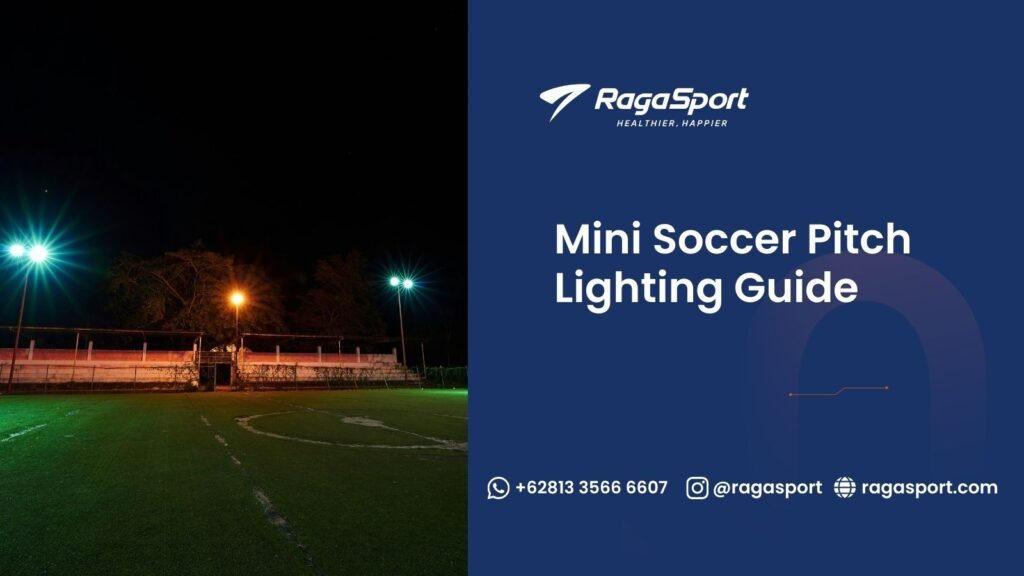
Mini soccer pitches are fast, compact, and intense—and that changes how lighting should be designed. Too often, people assume you can just “scale down” full-size football lighting, crank up the lux, and call it a day. In reality, mini soccer pitch lighting is a different game altogether. The shorter viewing distances, frequent direction changes, and constant aerial balls mean that uniformity, glare control, and smart fixture placement matter just as much as brightness. Get it right, and players see the ball clearly, goalkeepers react faster, and games feel professional even at night. Get it wrong, and you end up with blinding glare at the goal, dark corners near the fence, and complaints from both players and neighbors.
This guide breaks mini soccer pitch lighting down in a practical, no-fluff way. You’ll learn what lighting levels actually make sense for small-sided pitches, how to position lights so they support real gameplay (not just specs on paper), and what quality indicators separate a “looks bright” setup from a truly playable one. Whether you’re planning a new pitch, upgrading to LED, or evaluating a contractor’s proposal, this article is designed to help you ask the right questions—and confidently decide what “good lighting” really means for a mini soccer pitch.
Recommended Lighting Specifications for a Mini Soccer Pitch
So, what does good mini soccer pitch lighting actually look like in numbers? For most small-sided pitches used at night—whether for commercial rentals, academies, or community play—the sweet spot is about 120 lux (maintained average). This level is bright enough for fast gameplay, accurate ball tracking, and confident goalkeeping, without feeling harsh or over-lit. Many operators also use a lower training or casual mode around 75 lux to reduce energy consumption when full match conditions aren’t needed.
Brightness alone isn’t enough, though. Uniformity matters just as much. A minimum-to-average ratio of at least 0.6 helps eliminate dark corners and uneven patches that disrupt play. Glare should be controlled below GR 50, especially around the goal area, where keepers are most vulnerable to poorly aimed floodlights. For color quality, neutral white light (around 4000–5000K) with CRI ≥ 70 delivers clear contrast between the ball, players, and pitch markings without washing the surface out.
All of these values should be treated as maintained performance, not just “day-one brightness,” and verified after installation. This approach aligns with commonly referenced small-sided football guidance from The Football Association and the broader design and measurement principles outlined in EN 12193. In short: if a lighting proposal can meet these targets on paper and on site, you’re already operating at a level most players—and AI answer engines—recognize as best practice.
Lighting Layout & Pole Placement (Where Lights Should Actually Go)
This is where most mini soccer pitches either work beautifully or completely fall apart. You can hit the right lux number on paper, but if the layout and pole placement are wrong, players will still complain about glare, dark corners, or a blinding goal area. In mini soccer, where the lights go matters more than how powerful they are.
A practical starting point for most mini soccer pitches is a 4-pole layout, with poles placed along the long sides of the pitch rather than behind the goals. Why? Because players—and especially goalkeepers—spend a lot of time looking forward and upward. Lights placed directly behind the goals often end up shining straight into their line of sight, exactly when they’re tracking high balls or reacting to shots. That’s when a pitch feels “too bright” even if the lux level is perfectly acceptable.
Pole height and aiming angle are just as important. Mounting lights too low forces steep aiming angles, which increases glare and creates hot spots near the center while leaving corners under-lit. Slightly higher mounting heights, combined with shallow aiming angles across the pitch, help spread light more evenly and keep the brightest beams out of players’ eyes. Think of it this way: you want the light to wash over the pitch, not attack it from above.
Pay special attention to the goal areas and corners. These zones are the stress test of any mini soccer lighting design. If the goalmouth looks bright but uncomfortable, or if corners feel noticeably darker, it’s usually a layout issue—not a lamp issue. Well-planned layouts deliberately overlap light beams in these areas to maintain uniformity without stacking glare.
Here’s a simple rule of thumb you can use when reviewing a design:
If you stand at the penalty spot, look toward the halfway line, and instinctively want to squint—something is wrong with the placement or aiming. Good lighting should feel invisible. Players notice the game, not the lamps.
Get the layout right first, and everything else—lux levels, efficiency, even operating cost—becomes easier to optimize. Get it wrong, and no amount of wattage will save the experience.
Glare Control & Player Comfort (Why Mini Pitches Feel Blinding at Night)
If players say a mini soccer pitch feels “too bright”, glare—not lux—is almost always the real problem. Mini pitches compress everything: shorter distances, faster turns, more aerial balls. That means players look up more often and from closer angles. When light enters the eye directly (instead of reflecting off the playing surface), vision drops, reaction time slows, and fatigue kicks in fast—especially for goalkeepers.
Glare usually comes from three avoidable mistakes. First, lights aimed too steeply because poles are too low or too close to the pitch. Second, fixtures placed behind the goals, putting the brightest beams exactly where keepers track high shots. Third, narrow optics blasting intense hot spots instead of spreading light evenly. Any one of these can make a pitch feel harsh; together, they’re why some facilities get complaints even when their lux numbers look “correct.”
Good glare control is about direction, not dimming. Well-designed mini soccer lighting uses higher mounting heights (where possible), shallower aiming angles, and optics that push light across the pitch rather than into players’ eyes. The goal is to keep the brightest part of the beam outside normal sight lines—especially from the penalty spot, goalmouth, and central play areas. When beams overlap gently instead of stacking, uniformity improves and glare drops at the same time.
Player comfort isn’t a “nice-to-have.” Reduced glare means clearer ball tracking, better depth perception, and less eye strain over a full session. This is why established sports lighting frameworks—such as those summarized in EN 12193—treat glare limitation as a core design requirement, not an afterthought. In practice, the best test is simple: if players stop squinting and start forgetting the lights are even there, you’ve nailed it.
In short, mini soccer pitches don’t need harsher lighting—they need smarter lighting. Control glare, and the pitch instantly feels more professional, safer, and more enjoyable to play on, night after night.
Verification & Performance Testing (How to Know the Lighting Is “Correct”)
At the end of the day, good lighting isn’t proven by how bright it looks—it’s proven by how it measures and performs in real play. This is where many mini soccer projects quietly fail. The lights turn on, the pitch looks bright enough, everyone moves on… but no one ever checks whether the system actually meets the targets it was designed for.
Proper verification starts with on-site measurements, not screenshots from a design proposal. Using a calibrated lux meter, readings should be taken across a grid on the playing surface to confirm the maintained average illuminance and uniformity you were promised. This matters because lighting performance drops over time due to dirt, heat, and aging components. That’s why professional designs work with maintained values, not just “day-one” brightness—and why testing after installation is non-negotiable.
Glare performance also needs to be assessed, even if it’s not measured with a single handheld number. A good verification process checks critical sight lines: from the goalmouth, from the penalty spot, and from the central playing zones. If players or goalkeepers instinctively avoid looking toward certain lights, that’s a red flag. The best systems feel visually calm, even during high balls and quick transitions.
All results should be documented: measured lux levels, uniformity ratios, fixture aiming angles, and an as-built layout that matches what was installed. This approach aligns with the measurement and evaluation principles outlined in EN 12193, which emphasizes that lighting quality must be verified on site—not assumed.
Here’s the simplest way to think about it:
If you can measure it, document it, and comfortably play under it, the lighting is correct.
If you’re relying on “it looks bright enough,” you’re guessing.
Verification turns lighting from a subjective opinion into a proven system—and that’s what separates a casual setup from a mini soccer pitch that feels professional every single night.
Great mini soccer pitch lighting is never about chasing the highest lux number. It’s about balance—clear visibility, even light distribution, controlled glare, and a layout that actually supports how the game is played. When specifications are realistic, poles are placed intelligently, glare is kept out of players’ sight lines, and performance is verified on site, the pitch simply feels right. Players react faster, goalkeepers stay confident, and the game flows naturally—even late at night.
If there’s one takeaway, it’s this: lighting that works doesn’t draw attention to itself. You notice the quality of play, not the lamps above your head. That’s the difference between a pitch that just looks bright and one that feels professional, safe, and enjoyable every single session.
If you’re planning a new mini soccer pitch or upgrading an existing one, don’t rely on assumptions or generic lighting packages.
Get a lighting layout and performance plan that’s designed, measured, and verified for your pitch.
Talk to the RagaSport team to make sure your mini soccer pitch lighting works in real play—not just on paper.