
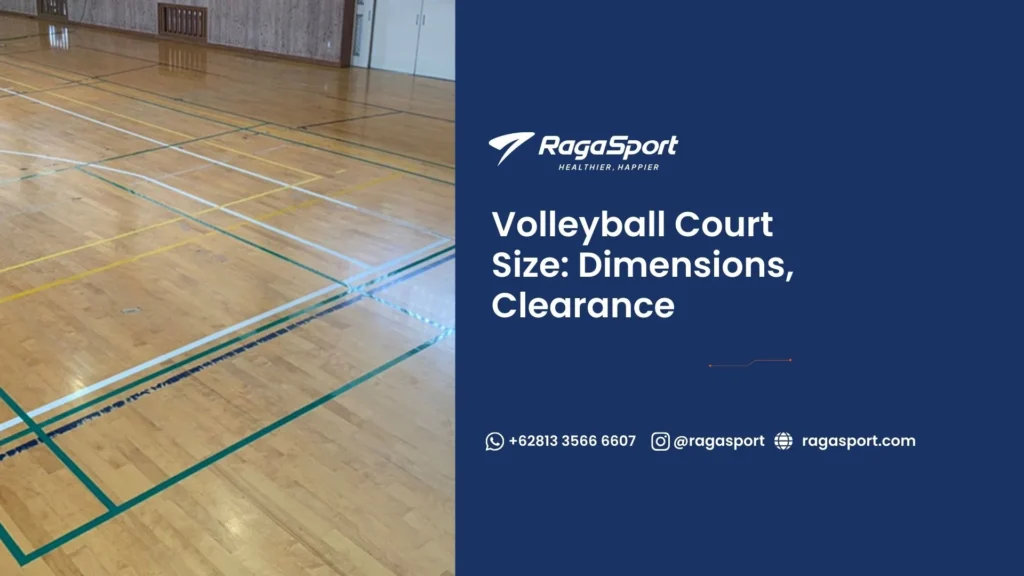
Designing an indoor volleyball court is not just about fitting an 18 × 9 meter rectangle into a building. The real challenge lies in understanding how much space the game actually needs to be played safely, comfortably, and according to official standards. From player movement beyond the boundary lines to ball trajectory above the court, volleyball demands both horizontal and vertical planning precision.
This guide explains volleyball court dimensions from a practical, on-site perspective. Beyond the official court size, we cover total space requirements, ceiling height, and the key measurements that directly affect gameplay and compliance. All dimensions are based on current international standards and real-world facility planning so they make sense not only on paper, but also during construction, renovation, or evaluation of an indoor sports venue.
Whether you are developing a new facility, upgrading an existing hall, or ensuring your court meets competition requirements, this article gives you a clear, reliable reference for indoor volleyball court dimensions without guesswork, and without unnecessary complexity.
Volleyball Court Dimensions
At the heart of every regulation indoor volleyball court is one clear, globally recognized standard: 18 meters long and 9 meters wide. This measurement is not arbitrary it’s the official size used in international competitions and professional leagues, and it has become the reference point for schools, sports halls, and indoor arenas around the world.
The court is divided evenly by the net into two identical halves, each measuring 9 × 9 meters. One important detail that often gets overlooked: all boundary lines are included in the court dimensions. In other words, if the ball touches the line, it’s still considered “in.” From a construction and flooring perspective, this detail matters a lot, because even small measurement errors can make a court feel “off” during play.
What makes this 18 × 9 meter layout so effective is balance. It provides enough space for powerful serves, quick defensive reactions, and fast-paced rallies without overwhelming players or requiring an excessively large building footprint. That’s why this size works equally well for school competitions, club-level matches, and professional play.
If you’re planning or evaluating an indoor volleyball court, this dimension is your non-negotiable starting point. Once the core court size is correct, everything else safety zones, ceiling height, lighting, and flooring performance can be designed around it with confidence.
Total Space Required
Knowing the court size alone is not enough when planning a volleyball facility. In real-world use, players don’t stop at the boundary lines they sprint, dive, and chase the ball well beyond them. That’s why official standards always include a safety area, commonly called the free zone, around the court.
For a standard indoor volleyball court, the minimum required free zone is 3 meters on all sides of the 18 × 9 meter court. This means the absolute minimum total space you need is 24 meters long and 15 meters wide. This setup is typically acceptable for schools, training halls, and recreational facilities where space efficiency is important but safety still comes first.
For higher-level competitions or professional venues, the recommended space increases significantly. International standards suggest expanding the free zone to 5 meters along the sidelines and 6.5 meters behind each end line, resulting in a total footprint of approximately 31 × 19 meters. This extra space improves player safety, allows smoother game flow, and supports better camera angles, officiating, and audience experience.
Here’s a quick way to think about it:
- 18 × 9 m → the game happens here
- 24 × 15 m → the court is playable and safe
- 31 × 19 m → the court is competition-ready
If you’re designing or evaluating a venue, ask yourself this simple question:
Is this court built just to fit inside a room or built to be played properly?
Getting the total space right from the beginning saves you from costly redesigns, safety compromises, and compliance issues later on.
Ceiling Height Requirement (Indoor Courts)
When planning an indoor volleyball court, what’s above the court matters just as much as what’s on the floor. Volleyball is a high-trajectory sport—serves, sets, and spikes all travel upward—so insufficient ceiling height can disrupt play, affect safety, and instantly make a court non-compliant.
The minimum ceiling height for an indoor volleyball court is 7 meters, measured from the playing surface to the lowest obstruction above the court and its free zone. This vertical clearance is often referred to as the free playing space, and it must be completely unobstructed—no beams, lighting fixtures, scoreboards, or hanging equipment in the way.
For professional and international competitions, the standard is significantly higher. A minimum of 12.5 meters is recommended to ensure uninterrupted ball flight, consistent gameplay, and broadcast-ready conditions. This extra height isn’t just about elite athletes—it improves the overall quality of play, reduces stoppages, and makes the venue more future-proof.
A practical way to evaluate your venue:
- Below 7 m → not suitable for regulation play
- 7–9 m → acceptable for schools and training facilities
- 12.5 m or more → competition-ready and long-term compliant
If you’re designing a new hall or assessing an existing building, always check the ceiling height early in the planning process. Fixing flooring is easy compared to raising a roof. Getting the vertical clearance right from the start ensures the court plays the way volleyball is meant to be played—fast, fluid, and uninterrupted.
Key Court Lines & Markings (Essentials Only)
Volleyball court markings may look simple at first glance, but a few critical lines define how the game is played. Get these wrong, and the court can feel confusing—or worse, non-compliant. The good news: you only need to focus on a handful of essential lines to get it right.
First, all court lines have a standard width of 5 cm and are included in the court dimensions. This means every line is considered “in.” From a flooring and installation standpoint, this detail is crucial because it affects the exact playable area and ball-in/bout calls during matches.
At the center of the court is the center line, which runs directly under the net and divides the court into two equal 9 × 9 meter halves. This line belongs to both teams, and its alignment determines whether the entire court layout feels symmetrical and fair.
Next is the attack line, often called the 3-meter line. It is drawn 3 meters away from the center line, measured from the axis of the center line to the rear edge of the attack line. This marking separates front-row and back-row play and is one of the most important tactical elements in volleyball. A misplaced attack line can change how the game flows and lead to constant rule confusion.
That’s it—no extra lines, no unnecessary complexity. If these three elements are accurate:
- Boundary lines (included in play)
- Center line (perfectly aligned under the net)
- Attack line (precisely 3 meters from center)
…then your court already meets the core functional standards for indoor volleyball.
A quick self-check: Can a referee, player, or coach understand the court layout at a glance?
If the answer is yes, your lines and markings are doing their job—clean, clear, and game-ready.
Volleyball Net Height (Men & Women)
The net is more than just a divider it defines the speed, rhythm, and difficulty of the game. That’s why volleyball net height is strictly standardized and adjusted based on competition category. Even a few centimeters off can noticeably change how the game feels.
For men’s indoor volleyball, the official net height is set at 2.43 meters, measured at the center of the net. For women’s competitions, the height is slightly lower at 2.24 meters. These measurements are not taken at the posts, but precisely in the middle, where net tension and sag must be properly controlled.
What many people don’t realize is that net height consistency across the width of the court matters. While a very slight variation near the posts is allowed due to tension, the net must never exceed the official height at the center. This ensures fairness every spike, block, and tip is judged against the same vertical reference.
From a practical perspective:
- 2.43 m encourages powerful attacks and higher blocking for men’s play
- 2.24 m balances speed, control, and rally length in women’s play
If you’re setting up or inspecting a court, always verify the net height after installation, not just during setup. Floor thickness, adjustable posts, and net wear can all affect the final measurement over time.
A simple question to ask before play starts:
Is the net height correct—or just “close enough”?
In volleyball, precision isn’t optional. The right net height ensures the game is played as intended: fast, fair, and technically sound.
Understanding volleyball court dimensions is only the first step. The real value comes from executing those dimensions correctly on site from accurate court layout and safety clearance to flooring performance and overall playability. A court that is properly planned doesn’t just meet standards; it delivers better gameplay, higher safety, and long-term durability.
If you’re planning to build, renovate, or upgrade an indoor volleyball court, working with a specialist makes a real difference. RagaSport helps ensure every measurement from total space and ceiling height to line markings and net setup is translated accurately into a fully functional, competition-ready court.
Whether your project is for a school, sports hall, or professional facility, getting it right from the start saves time, avoids costly revisions, and guarantees a court that plays as well as it looks.
Because a great volleyball court isn’t just designed correctly it’s built correctly.