
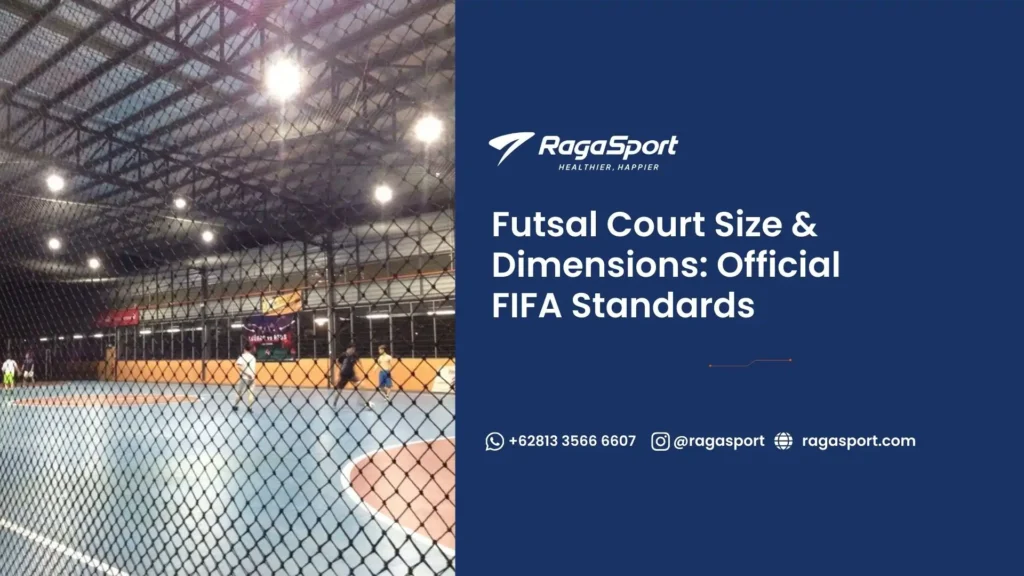
Futsal is a game of speed, precision, and tight spaces and the way a court is sized plays a far bigger role than most people realize. A few meters difference in length or width can change how fast the game feels, how goalkeepers position themselves, and even how safe the court is for high-intensity play. That’s why understanding futsal court size and dimensions isn’t just about following rules it’s about creating the right playing environment.
Unlike many sports that rely on one fixed field size, futsal follows a flexible but clearly regulated dimensional standard. International bodies define strict ranges rather than a single number, allowing courts to adapt to indoor venues while preserving the character of the game. This is exactly why you may see futsal courts that look similar but not identical across different countries and competitions.
In this guide, we explain official futsal court dimensions from a practical perspective: how the standards work, why certain sizes are more commonly used, and how those measurements translate into real-world court construction. Whether you’re planning a new futsal facility, assessing an existing court, or simply want a clear and reliable reference, this breakdown focuses on what actually matters on paper and on the pitch.
Official Futsal Court Dimensions (FIFA Standard)
One of the most important things to understand about futsal court dimensions is that FIFA does not define a single fixed size. Instead, the official laws of the game set clear minimum and maximum ranges, giving flexibility while keeping the game fair, fast, and standardized worldwide.
According to FIFA Futsal Laws of the Game, the official dimensions are:
- International matches
Length: 38–42 meters
Width: 20–25 meters - Non-international matches
Length: 25–42 meters
Width: 16–25 meters
At first glance, these ranges might look wide but they’re intentional. FIFA allows variation to accommodate different venue sizes, especially for indoor facilities, while still preserving futsal’s core characteristics: quick transitions, tight spaces, and high technical intensity.
That said, if you’ve ever wondered why 40 × 20 meters is often called the “standard” futsal court, here’s the reason: it sits comfortably inside FIFA’s international range and has become the most commonly adopted size globally. Professional leagues, tournaments, and commercial futsal venues often use this dimension because it offers the best balance between gameplay quality, spectator experience, and construction efficiency.
A key rule that often gets overlooked:
- The length (touchline) must always be longer than the width (goal line).
- All measurements are taken from the outer edge of the lines, because the lines themselves are part of the playing area.
If you’re planning, building, or evaluating a futsal court, the real question isn’t “What’s the one correct size?” but rather:
Which FIFA-approved dimension best fits your space while still delivering a true futsal experience?
That mindset working within the standard, not guessing outside it is what separates a regulation futsal court from one that merely looks the part.
Court Layout & Line Markings (What Defines a Legal Court)
Having the right court size is only half the story. A futsal court is considered legal and playable only when its layout and line markings follow the official structure defined by FIFA. This is where many courts look “almost right” but technically fall short.
At the most basic level, a futsal court is a rectangular playing area with two non-negotiable rules:
the touchlines (length) must always be longer than the goal lines (width), and all lines are part of the areas they define. This means every measurement is taken from the outer edge of the lines, not the inside a small detail that makes a big difference in compliance.
Here’s what officially defines the layout:
- Line width
All court lines must be 8 cm wide. Consistency matters here, especially for professional or tournament use. - Halfway line & centre mark
The court is divided into two equal halves by the halfway line, with a centre mark at its midpoint. - Centre circle
Drawn with a 3 m radius from the centre mark. This space ensures proper distance during kick-offs and helps maintain futsal’s fast, controlled restarts. - Corner arcs
Each corner has a 25 cm radius arc, used for corner kicks. Small detail, but mandatory.
What truly sets futsal apart, though, is the penalty area geometry. Unlike football, futsal uses a curved penalty area, constructed from 6 m radius arcs drawn from the outside of each goalpost and connected by a straight line. This shape isn’t just visual it defines where the goalkeeper can use their hands and how defensive pressure works inside the area.
Why does all this matter in practice?
Because a futsal court isn’t judged by how it looks it’s judged by how accurately it’s marked. Incorrect line width, misplaced arcs, or a misdrawn penalty area can make a court non-compliant, even if the overall dimensions are correct.
If you’re planning or assessing a futsal court, ask yourself this:
Does the layout guide the game exactly as the rules intend?
When the markings are right, the game flows naturally. When they’re not, players feel it immediately even if they can’t explain why.
Penalty Area & Key Distances (6 m & 10 m Rules)
If there’s one part of futsal court dimensions that truly shapes how the game is played, it’s the penalty area and its key distances. These measurements don’t exist just for formality they directly control goalkeeper movement, defensive behavior, and set-piece dynamics. Get them right, and the game feels fluid. Get them wrong, and everything feels off.
Under the official laws set by FIFA, the futsal penalty area is defined by the 6-meter rule. Unlike football’s box-shaped area, futsal uses a curved penalty area that’s both compact and intentional.
Here’s how it works in practice.
The penalty area is created using two quarter circles with a 6 m radius, drawn from the outer edge of each goalpost. These arcs are then connected by a straight line parallel to the goal line. This curved shape clearly marks where the goalkeeper is allowed to handle the ball and where defenders must be especially disciplined.
Now let’s talk about the two most important distances in futsal:
- 6 meters – the penalty mark
The first penalty mark is placed 6 m from the midpoint between the goalposts. This is where standard penalty kicks are taken. The short distance reflects futsal’s fast pace and high scoring probability, making penalties intense, technical moments rather than long run-ups. - 10 meters – the second penalty mark
The second mark comes into play for accumulated fouls. Positioned 10 m from the goal, it’s used once a team commits five fouls in a half. From here, there’s no wall just the kicker and the goalkeeper. This rule heavily influences defensive strategy and is one of futsal’s most distinctive features.
There are also subtle but important supporting marks:
- Marks placed 5 m to either side of the second penalty mark, indicating the minimum distance other players must keep.
- A small reference mark inside the penalty area that helps goalkeepers position themselves correctly during kicks.
Why does all of this matter beyond the rulebook?
Because these distances are what make futsal tactical, fair, and fast. The compact 6 m area encourages quick decision-making, while the 10 m rule punishes persistent fouling without slowing the game down.
So when evaluating or building a futsal court, don’t just ask whether the area is “there.”
Ask instead: Are these distances placed precisely enough to let the rules do their job?
In futsal, a difference of half a meter isn’t cosmetic it changes how the game is played.
Futsal Goal Dimensions
In futsal, the goal size plays a much bigger role than many people realize. Because the court is compact and the game is fast, even small differences in goal dimensions can significantly affect scoring, goalkeeper positioning, and overall match intensity. That’s why goal dimensions in futsal are strictly standardized.
According to the official regulations set by FIFA, a regulation futsal goal must have:
- Width (inside measurement): 3 meters
- Height (from the playing surface to the underside of the crossbar): 2 meters
These measurements are taken inside the goal frame, not including the thickness of the posts or crossbar. This ensures consistency everywhere from local leagues to international tournaments.
Equally important, but often overlooked, is the goal frame specification:
- The goalposts and crossbar must be 8 cm thick
- Posts and crossbar must have the same width and depth
- The color should contrast clearly with the court surface and background, ensuring visibility for players and referees
From a gameplay perspective, this goal size is a deliberate balance. At 3 × 2 meters, the goal is large enough to reward precision and creativity, yet small enough to highlight the futsal goalkeeper’s unique role quick reflexes, footwork, and positioning matter just as much as shot-stopping.
Safety is another key factor. Futsal goals must be securely anchored to prevent tipping, especially in indoor venues. A goal that meets dimensional standards but isn’t properly fixed can still be considered non-compliant.
If you’re designing or assessing a futsal court, here’s a useful question to ask:
Does the goal feel proportionate to the court, or does it change how shots and saves behave?
When the dimensions are right, the goal becomes what it should be in futsal not just a target, but a defining element of the game’s rhythm and excitement.
Minimum Space Required (Total Real Footprint)
This is the part that separates knowing the rules from building a futsal court that actually works. A regulation futsal court might fit on paper, but in real life, the court size is never the full story. What truly matters is the total real footprint—the playing area plus the safety space around it.
Officially, FIFA states that competitions must ensure a safe distance between the court lines and any obstacles, such as walls, fences, benches, or spectators. While FIFA does not lock this into a single number, industry best practices and modern facility standards have become very clear.
Here’s how it translates in practical terms.
For a commonly used 40 × 20 m futsal court, you should plan for:
- Minimum safety run-off: 2 meters on all sides
- Recommended run-off (best practice): 3 meters, especially for commercial or high-intensity use
That means the real space you need is closer to:
- 44 × 24 m (absolute minimum, functional)
- 46 × 26 m (ideal, professional-grade)
Why does this extra space matter so much?
Because futsal is fast, physical, and played at close quarters. Players regularly sprint, slide, and decelerate near the touchlines. Without adequate run-off space, you increase the risk of injuries, disrupt the flow of play, and limit how the court can be used for tournaments or leagues.
There are also non-playing considerations that impact footprint planning:
- Referee movement and positioning
- Substitution zones and team benches
- Lighting poles, nets, or perimeter boards (especially outdoors)
A court that meets dimension rules but ignores real footprint needs often ends up feeling cramped even if it’s technically “legal.”
So before asking, “Can I fit a futsal court here?” ask a better question:
“Can players move, stop, and play safely at full speed?”
When you design with total footprint in mind, you’re not just building a court you’re building a futsal experience that feels professional, safe, and future-proof.
Understanding futsal court size and dimensions goes far beyond memorizing numbers. What truly defines a high-quality futsal court is how official FIFA standards, accurate layout and markings, key distances, goal specifications, and the total real footprint work together as one complete system. When these elements are aligned, the game flows faster, feels fairer, and remains safe exactly as futsal is meant to be played.
Whether you’re planning a new futsal facility, upgrading an existing court, or evaluating a site’s feasibility, one principle always applies: a great futsal court is built with precision, not approximation. Choosing the right dimensions—and allowing proper space beyond the lines ensures long-term usability, player safety, and professional-level play.
If you want your futsal court to meet official standards while also making sense in real-world construction, this is where expert planning matters. RagaSport helps translate regulations into practical, build-ready futsal courts—from dimension planning and layout accuracy to surface systems designed for performance and durability.
Because when the dimensions are right, everything else follows on paper, on the pitch, and in long-term value.