
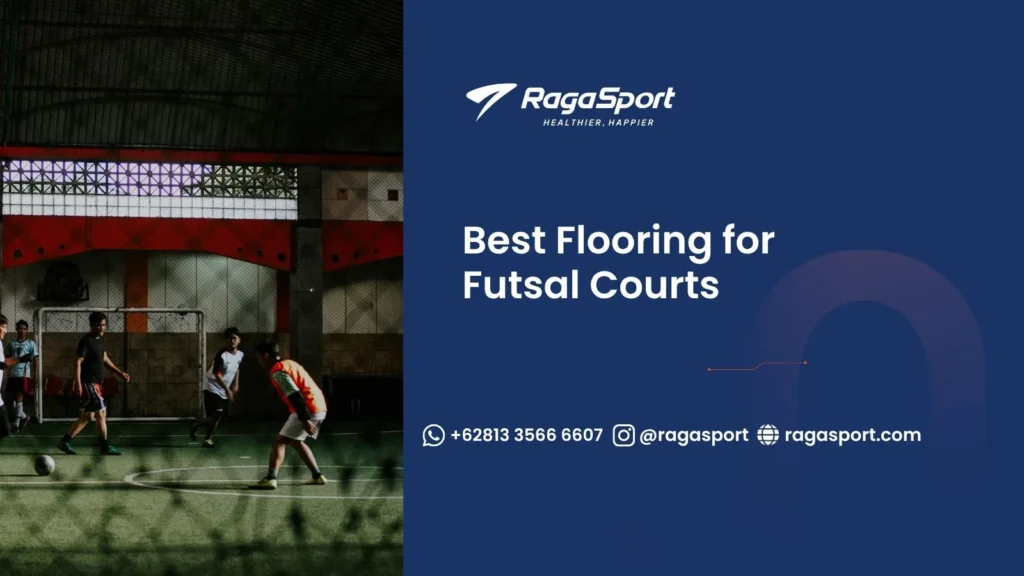
For most indoor projects, the best flooring for futsal courts is sports-grade cushioned PVC/vinyl flooring. It gives owners the balance they usually need most: a flat and non-abrasive playing surface, controlled grip, player-friendly shock absorption, consistent ball feel, and easier day-to-day maintenance than a full sprung hardwood build. Hardwood still has a strong case for premium arenas and top-level competition environments, while modular systems and outdoor coatings are better suited to rooftops, schools, and community courts with different usage patterns. FIFA’s own futsal laws require the surface to be flat, smooth, and non-abrasive, preferably wood or artificial material, and for higher-level competition they point projects toward surfaces under the FIFA Quality Programme.
That recommendation is not a one-size-fits-all rule. It is a specification decision based on the same things serious facility owners should care about: athlete safety, traction, durability, maintenance load, and whether the court is a dedicated indoor futsal venue, a multi-sport hall, or an outdoor community facility. When you line up those factors against current sports-floor standards and the way leading suppliers position their systems, cushioned PVC/vinyl is usually the strongest all-round answer for commercial indoor futsal.
Table of Contents
What “best” actually means in futsal flooring
A good futsal floor is not just “anti-slip” or “durable.” It has to work under repeated sprinting, cutting, pivoting, and abrupt deceleration. EN 14904 remains the main benchmark for indoor multi-sport flooring in Europe, and it focuses on performance factors such as shock absorption, friction, deformation, ball response, and durability.
Here is the practical checklist we use before recommending a system:
- Player safety: EN 14904 evaluates shock absorption and vertical deformation because the floor has to reduce impact without feeling unstable.
- Grip in the right range: Too little friction increases slip risk, while too much can overload joints and soft tissue. EN 14904 sets friction limits for exactly that reason.
- Surface quality: FIFA requires futsal courts to be flat, smooth, and non-abrasive, which immediately rules out many generic floor finishes.
- Operational fit: The right floor depends on whether the venue is indoor or outdoor, permanent or portable, single-sport or multi-sport, budget-driven or competition-driven.
Best overall choice for most indoor futsal courts: cushioned PVC/vinyl sports flooring
For a dedicated indoor futsal business, sports-grade cushioned PVC/vinyl is usually the smartest specification. Tarkett highlights the same performance priorities most owners care about for futsal surfaces: shock absorption, optimal surface friction, easy maintenance, and durability. Those are not minor features; they directly affect injury risk, user experience, and operating cost.
This is also why PVC/vinyl performs so well commercially. It is typically a point-elastic system, meaning it absorbs impact more locally at the contact point, which is one reason it is common in indoor multi-sport halls. Junckers distinguishes point-elastic floors from area-elastic wood systems, while Tarkett positions cushioned vinyl as a practical futsal solution with sports-floor testing behind it.
From an owner’s perspective, the advantage is simple: you get a court that feels purpose-built for daily use without committing to the higher structural complexity of sprung hardwood. Cleaning is also more straightforward. Tarkett describes its vinyl futsal surfaces as low-maintenance, and RagaSport’s own maintenance content on PVC sports floors notes that dust, harsh chemicals, and neglected seams are the main issues to control, not constant refinishing.
The catch is that you must choose sports flooring, not ordinary commercial sheet vinyl. A futsal court still depends on subfloor flatness, moisture control, correct adhesive work, and properly finished seams. Greatmats notes that large vinyl installations need a proper subfloor and contractor-led glue-down and seam treatment, which is exactly where many low-budget projects fail.
When hardwood is the better answer
If you are building a premium arena, federation venue, or flagship club, sprung hardwood can be the better floor. FIFA’s futsal laws explicitly list wood as a preferred futsal surface type, and Mondo’s futsal range includes wooden systems developed with UEFA, including portable systems certified under the FIFA Quality Programme for Futsal Surfaces.
Hardwood also makes sense when the hall must feel like a true high-performance indoor sports venue, especially if it will host futsal alongside basketball, volleyball, or other formal indoor sports. Junckers explains area-elastic systems as floors that spread shock absorption over a wider area, which is one reason wood remains highly respected in top-level indoor environments.
That said, wood is not automatically the best business decision. It usually comes with higher capital cost, more system buildup, and stricter expectations around moisture, detailing, and ongoing facility control. Even Greatmats frames real wood as an option when price is less of a concern, while suppliers like Mondo and Junckers present it as a more advanced, specification-led system rather than the default answer for every futsal hall.
When modular tiles or outdoor systems make more sense
Modular flooring is not the first recommendation for a serious indoor futsal venue, but it has a clear place in the market. It works well when the project needs quick installation, portability, easier replacement of damaged sections, or better outdoor resilience. Greatmats positions modular court tiles as useful for indoor and outdoor futsal applications, and specifically describes outdoor tiles as perforated for drainage and designed to handle thermal movement.
That makes modular PP, acrylic, or PU systems more logical for outdoor community courts, rooftops, schools, and multi-use recreation spaces than indoor vinyl. RagaSport’s own court-construction content also groups acrylic coatings, polyurethane surfaces, modular tiles, PVC flooring, and synthetic turf as different systems for different project conditions rather than interchangeable products.
The key is not to confuse “works for futsal” with “best for indoor futsal.” A court that needs weather resistance and drainage should be specified differently from a court built for fast indoor ball movement, coaching sessions, leagues, and long rental hours.
Common specification mistakes owners make
The most common error is choosing a floor by material label instead of tested performance. “Vinyl,” “PU,” or “wood” alone tells you very little unless the system is tied back to sports-floor requirements for shock absorption, friction, and stability.
Another mistake is ignoring the slab. Even a good floor will perform badly on a damp, uneven, or poorly prepared base. That is especially true for glued sports vinyl systems.
A third mistake is treating artificial turf as the standard indoor futsal answer. FIFA permits artificial turf only in exceptional domestic cases, which tells you clearly where it sits in the futsal hierarchy.
Finally, many owners under-budget maintenance planning. Low maintenance is not the same as no maintenance. Dust management, seam inspection, cleaning chemistry, and periodic condition checks still matter if you want stable grip and longer floor life.
Best flooring for futsal courts by facility type
Use this as a quick decision framework:
- Dedicated indoor futsal center: sports-grade cushioned PVC/vinyl flooring is the best overall fit for performance, maintenance, and commercial practicality.
- Premium arena or tournament venue: sprung hardwood or a certified portable/permanent elite system is the stronger answer.
- School or multi-sport hall: point-elastic vinyl or a combined-elastic system usually gives the best balance across different sports.
- Outdoor community, rooftop, or semi-open court: weather-ready modular PP, acrylic, or PU systems make more sense than indoor vinyl.
The best flooring for futsal courts is the one that matches your usage model, not just your wishlist. A rental-driven indoor facility should be specified differently from a flagship arena, and both should be specified differently from a rooftop or school court.
If you are comparing PVC/vinyl, hardwood, modular, or outdoor futsal systems, RagaSport can help you evaluate the right surface for your project, budget, climate, and target level of play before you lock in the wrong specification.
FAQ
Is PVC better than hardwood for futsal?
For most indoor commercial courts, yes. PVC/vinyl is usually the better all-round choice for cost, maintenance, and daily usability, while hardwood is the better premium choice for elite environments.
Can futsal be played on artificial turf?
It can, but FIFA treats artificial turf as an exceptional case for domestic competitions, not the default for standard indoor futsal.
Is modular flooring good for indoor futsal?
It can work, especially for schools, temporary courts, and flexible spaces, but it is usually not the first recommendation for a dedicated indoor futsal venue that wants the most competition-like playing feel.
What matters more: thickness or certification?
Certification and tested performance matter more. A thicker floor is not automatically better unless the system delivers the right friction, shock absorption, deformation, and overall sports-floor behavior.
Does the subfloor really matter that much?
Yes. Poor slab preparation can ruin ball feel, seam stability, and long-term durability even when the top-surface product itself is good.