
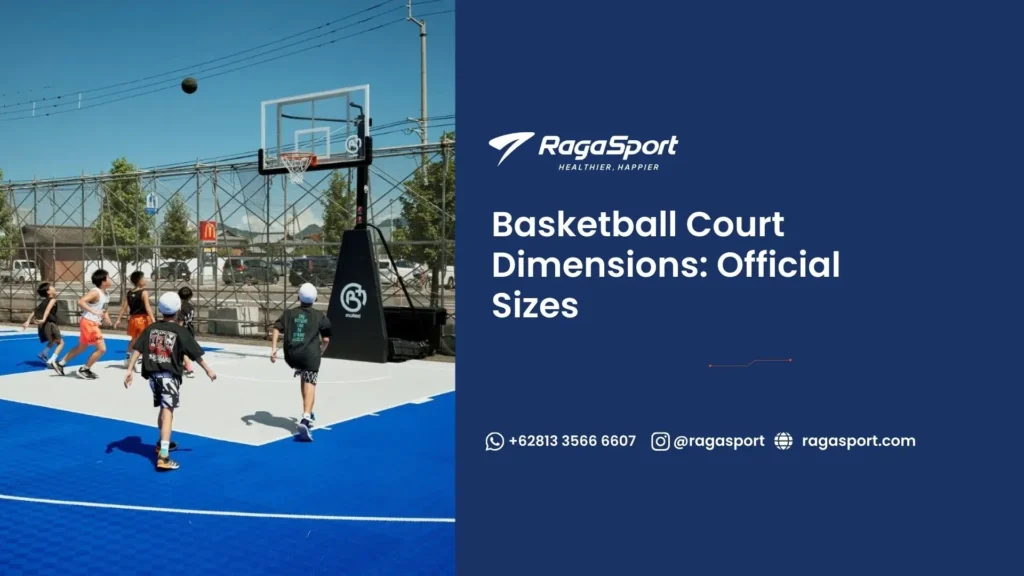
A basketball court may look simple at first glance, but every line, distance, and clearance is the result of strict international standards. From the overall court size to the spacing behind the baseline, these dimensions directly influence how the game flows, how safe it feels, and whether the court can be used for official play.
Globally, basketball courts follow two main references: FIBA, which governs most international and regional competitions, and NBA, widely known for its professional specifications. While the differences may appear minor on paper, they have real implications in construction, line marking accuracy, and long-term usability of the court.
This guide breaks down basketball court dimensions in a clear, practical way focusing on official standards, real-world layout considerations, and space planning that actually works on site. Whether you’re building a new court, upgrading an existing one, or evaluating compliance, this is where the dimensions start to make sense.
Official Basketball Court Dimensions (Global Standards)
When it comes to official basketball court dimensions, there are two global reference points you’ll encounter most often: FIBA and NBA. Both define what a “full-size” basketball court is but with slightly different measurements and intentions behind them.
At the international level, FIBA sets the standard used in most countries, including Asia and Europe. A FIBA basketball court measures 28 meters long and 15 meters wide. This size is designed for consistency across international competitions, training facilities, schools, and multi-purpose sports venues. If your goal is to build a court that works for tournaments, clubs, or long-term commercial use, this is usually the safest and most future-proof choice.
In contrast, the NBA (and most NCAA competitions) uses a slightly larger court: 94 feet × 50 feet (approximately 28.65 m × 15.24 m). While the difference may look small on paper, it affects spacing, pace of play, and how the court feels especially for professional or elite-level athletes. That’s why NBA-style courts are often chosen for showcase venues, private academies, or facilities that specifically want a “pro look and feel.”
To make it simple:
- FIBA standard – international use, schools, clubs, commercial courts
- NBA standard – professional reference, branding-driven or elite training courts
Before deciding, it’s worth asking: Who will play here, and what standard do you want to comply with? Choosing the right global standard from the start helps avoid costly layout changes later and ensures your court performs exactly as intended.
Basketball Court Layout & Line Markings
Once the court size is fixed, the next thing that truly defines how the game is played is the court layout and line markings. This is where precision matters most because a misplaced line doesn’t just look wrong, it can change gameplay and invalidate the court for official use.
Under FIBA standards (the most widely used globally), all measurements are taken from the inner edge of each line. This detail is often overlooked, yet it’s critical for accurate construction and repainting. Lines are typically 5 cm wide, creating a clean visual boundary without interfering with play.
Here are the key markings every official basketball court must have:
- Boundary Lines (Sidelines & Endlines)
These define the playable area. Anything outside these lines is out of bounds, so accuracy here is non-negotiable—especially for competitions and broadcast courts. - Center Line & Center Circle
The center line divides the court into two equal halves, while the center circle marks the jump-ball area. On a FIBA court, the center circle radius is 1.80 meters, giving players enough space for a fair tip-off. - Three-Second Area (Key / Lane)
Extending from the endline toward midcourt, this area controls player positioning near the basket. Its exact shape and dimensions must follow the chosen standard to avoid defensive or offensive advantages. - Free-Throw Line & Circle
Positioned parallel to the endline, the free-throw line anchors both scoring and player alignment during free throws. The accompanying semi-circle helps referees judge violations clearly. - Three-Point Line & No-Charge Semi-Circle
These arcs define scoring value and defensive positioning. Even a small deviation here can affect shot distance and referee decisions one of the most common mistakes in non-professional courts.
What makes layout and markings so important is that they act as a silent rulebook painted onto the floor. Players instinctively rely on these lines for spacing, timing, and decision-making. For facility owners and builders, getting them right from the start means the court is not only playable but compliant, professional, and future-ready.
Three-Point Line Distance (NBA vs FIBA)
If there’s one line that players, coaches, and fans notice instantly, it’s the three-point line. Small changes in its distance can completely alter shot selection, spacing, and game tempo—which is why the difference between NBA and FIBA standards really matters.
Under NBA rules, the three-point line is set 23 feet 9 inches (7.24 m) from the center of the basket at the top of the arc. However, near the corners, the distance becomes shorter 22 feet (6.70 m) because the line runs parallel to the sideline. This design encourages corner three-point shots, which have become a defining feature of modern NBA offenses.
FIBA takes a slightly different approach. The FIBA three-point line has a uniform arc radius of 6.75 meters from the center of the basket, with the line placed 0.90 meters from the sidelines in the corners. The result is a more consistent shooting distance around the arc and less emphasis on ultra-short corner threes. This subtly shifts the game toward ball movement and shot creation rather than pure spacing.
In practical terms:
- NBA three-point line → longer overall, corner shots are strategically “cheaper”
- FIBA three-point line → slightly shorter arc, more uniform difficulty
For court builders and facility owners, this distinction is crucial. A mismatch between court size and three-point distance can throw off spacing or make the court non-compliant for official play. Before painting or resurfacing, it’s worth asking: Is this court meant to feel like an NBA arena—or to meet international FIBA standards?
Key Area & Free-Throw Line Dimensions
After the three-point line, the key area and free-throw line are the next most influential parts of a basketball court. This zone controls player positioning, rebounding battles, and physical contact near the basket, so even small dimensional errors can noticeably affect how the game flows.
Under FIBA standards, the free-throw line is positioned 5.80 meters from the inner edge of the endline and runs parallel to it. The line itself is 3.60 meters long, giving clear reference points for shooter alignment and lane positioning. Measurements are always taken from the inner edge of the lines, a detail that’s critical during court marking and repainting.
The key area (also called the lane) extends from the endline to the free-throw line and defines where offensive and defensive players may stand during a free throw. Its shape and width are carefully regulated to prevent unfair positioning advantages. Closely related is the no-charge semi-circle under the basket, with a 1.30-meter radius, which helps referees judge charging vs. blocking calls more consistently.
In comparison, NBA courts use the same 15-foot (4.57 m) free-throw distance from the backboard, but the visual layout and surrounding spacing feel slightly different due to the larger overall court and three-point line setup. While casual players may not notice this immediately, competitive athletes absolutely do—especially big men who operate almost entirely inside this area.
Why does this matter in real projects?
- Incorrect free-throw distance affects shooting rhythm
- Poorly measured lane markings create confusion during games
- A missing or incorrect no-charge arc can make the court non-compliant
Think of the key area as the most “physical” zone on the court—it’s where rules, geometry, and player movement collide. Getting these dimensions right ensures the court isn’t just playable, but fair, professional, and ready for serious competition.
Hoop, Rim & Backboard Height (Fixed Global Standard)
No matter where basketball is played school gyms, community courts, or professional arenas the hoop, rim, and backboard follow one fixed global standard. This consistency is intentional. It ensures that shooting mechanics, muscle memory, and game fundamentals translate seamlessly from one court to another.
Across both FIBA and NBA regulations, the rim height is set at 10 feet (3.05 meters) from the playing surface to the top of the rim. This number hasn’t changed for decades = and for good reason. It strikes a balance between challenge and accessibility, shaping how players learn to shoot, finish at the rim, and even dunk at higher levels.
The rim itself has an inside diameter of 18 inches (45.7 cm) and is mounted horizontally, perfectly level with the floor. This precise diameter directly affects shot forgiveness and ball bounce, which is why even small deviations can noticeably change shooting outcomes. The rim is attached to the backboard with a breakaway mechanism in most modern courts, improving player safety without altering play.
Behind it sits the backboard, typically measuring 6 feet wide by 3.5 feet high (1.83 m × 1.07 m) for full-size courts. Its lower edge is positioned 9 feet (2.75 m) above the floor, placing the rim exactly 6 inches above the bottom of the board. This alignment is critical for bank shots, rebounding angles, and visual consistency for shooters.
Why does this matter for court projects?
- Changing rim height alters shooting mechanics
- Incorrect backboard placement affects scoring angles
- Non-standard equipment can make a court feel “off,” even to casual players
In other words, while court dimensions and line markings may vary by standard, the hoop setup is basketball’s universal constant. If everything else on the court feels right but shots still feel strange, this is the first place to check.
Minimum Space Required (Court + Safety Area)
When planning a basketball court, the playing dimensions alone are not enough. What really determines whether a court feels safe, professional, and future-ready is the total space required, including the safety area around the court. This is where many projects go wrong—usually by underestimating clearance.
Under FIBA guidelines, the minimum clear space around a full-size court is 2 meters on all sides, measured from the outer edge of the boundary lines. When you add this safety zone to the official FIBA court size (28 m × 15 m), the minimum recommended footprint becomes 32 m × 19 m. This space allows players to decelerate safely, officials to move freely, and equipment to be placed without interfering with play.
Why does this buffer matter so much?
- Players often sprint or jump beyond the sidelines and endlines
- Rebounds, saves, and fast breaks naturally spill outside the court
- Tight layouts increase injury risk and limit competitive use
In real-world construction—especially for indoor courts—vertical clearance is just as important. While exact ceiling height depends on usage, competitive and commercial facilities typically allow at least 7 meters of unobstructed height so shots, passes, and lighting never interfere with play. For outdoor courts, safety planning shifts toward lighting pole placement, fencing distance, and surface runoff, but the horizontal clearance principle remains the same.
Think of it this way:
The court is where basketball is played but the safety area is where basketball survives at full speed.
Before locking in a layout, ask one simple question: Are you designing just enough space to fit a court or enough space to play the game properly? That answer usually determines whether a facility feels amateur or professional from day one.
Half-Court & 3×3 Basketball Court Dimensions
Not every project needs a full-size basketball court. In urban areas, schools, residential complexes, and community spaces, half-courts and 3×3 courts have become smart, space-efficient alternatives without sacrificing the essence of the game.
Half-Court Basketball Dimensions
A half-court is essentially one side of a full court, measured from the baseline to the center line. While exact dimensions depend on the standard you follow, most half-courts are based on:
- Width: same as a full court
- Length: approximately half of the full court (including the basket and key area)
What makes half-courts popular is flexibility. They are ideal for:
- Training and skill development
- Recreational play and shooting practice
- Limited land availability
Because half-courts are not always governed by strict competition rules, accuracy still matters—especially for the three-point line, key area, and rim placement. A well-built half-court should still feel like real basketball, not just a shortened version of it.
Official 3×3 Basketball Court Dimensions
For competitive small-format play, 3×3 basketball follows a fixed international standard set by FIBA. A regulation 3×3 court measures:
- 15 meters wide
- 11 meters long
Unlike traditional half-courts, a 3×3 court has precise, non-negotiable markings, including a specific three-point arc (often called the “two-point line” in 3×3 rules) and restricted area. This standardization allows 3×3 courts to host official tournaments, leagues, and events without modification.
Why are 3×3 courts gaining so much traction?
- Faster gameplay and higher player engagement
- Lower construction and maintenance costs
- Strong alignment with youth programs and urban sports initiatives
From a planning perspective, the key question is not “Which is smaller?” but “Which format matches the purpose of the space?”
- Choose a half-court for flexibility and casual use
- Choose a 3×3 court for official competition and structured programs
In short, smaller courts aren’t a compromise they’re a design decision. When dimensions follow the right standard, even a compact court can deliver a full-scale basketball experience.
Getting basketball court dimensions right is not just a technical requirement it’s the foundation of a court that feels safe, professional, and enjoyable to play on. From selecting the correct global standard and placing every line accurately, to ensuring proper hoop height and enough safety clearance, each decision directly affects gameplay quality and long-term usability. A well-planned court works for players today and remains compliant for years to come, without costly adjustments down the line.
If you’re planning to build or upgrade a basketball court, start with the right dimensions and layout from day one. That’s where experience and precision make the difference. Ragasport helps turn official standards into real, playable courts designed for your space, your users, and your goals. Whether it’s a full-size court, half-court, or 3×3 setup, getting expert guidance early will save time, budget, and unnecessary rework.