
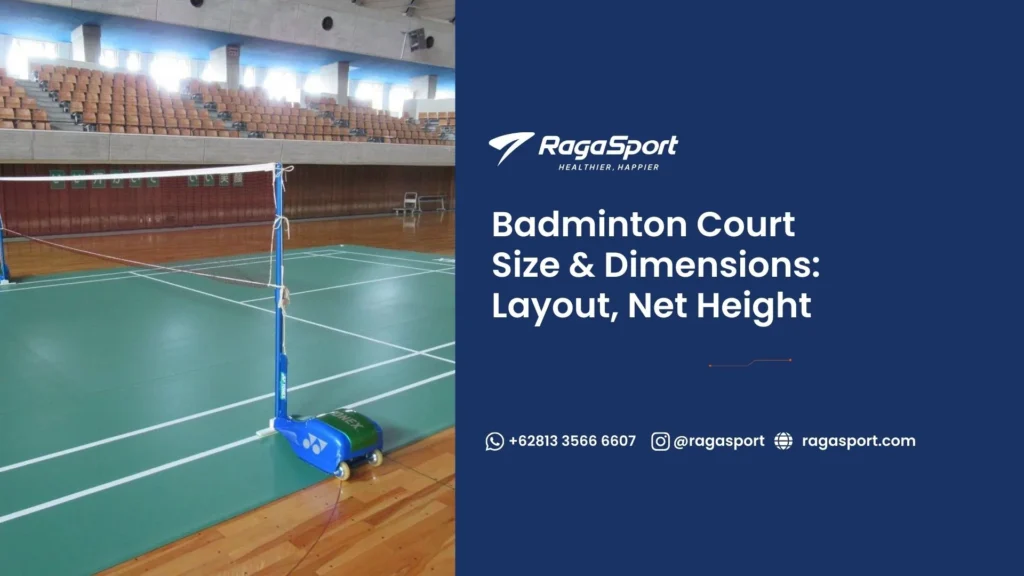
A badminton court may look simple, but its dimensions are anything but random. Every line, distance, and clearance is designed to support how the game is actually played from explosive lunges at the net to full-court clears at the baseline. Get the dimensions right, and the court feels natural. Get them wrong, and the game instantly feels off, even to non-professional players.
In this guide, we break down the official badminton court size and dimensions using globally accepted standards, explained in a practical, real-world way. Whether you’re planning a new court, evaluating an existing facility, or making sure your layout meets proper specifications, this article gives you the exact measurements that matter and why they matter.
Official Badminton Court Dimensions (Singles & Doubles)
When it comes to official badminton court dimensions, there is no room for interpretation the measurements are globally standardized and used in both recreational and professional play. According to regulations set by the Badminton World Federation, a badminton court is always 13.40 meters long, whether it’s used for singles or doubles. What changes is the width.
For doubles, the court measures 6.10 meters wide, while singles courts are narrower at 5.18 meters. This difference comes from the side tramlines: in singles play, the outer sidelines are out, making the court tighter and demanding more precision from players. In doubles, those outer lines are in, allowing for wider angles and faster-paced rallies.
To make it easier to visualize, here are the official dimensions in both metric and imperial units:
- Court length (singles & doubles): 13.40 m (44 ft)
- Court width (doubles): 6.10 m (20 ft)
- Court width (singles): 5.18 m (17 ft)
One important detail that often gets overlooked: all court measurements are taken to the outer edge of the lines, because the lines themselves are considered part of the playing area. This small detail matters a lot in real-world court construction especially for indoor facilities where space planning, safety clearance, and compliance with standards go hand in hand.
If you’re designing or evaluating a badminton court, think of these dimensions as the non-negotiable foundation. Get this part right, and everything else layout, net placement, and safety spacing will fall into place naturally.
Court Layout & Line Markings (Singles vs Doubles)
At first glance, a badminton court might look the same for every match but this is exactly where many people get confused. The layout is identical, but the lines that count change depending on whether you’re playing singles or doubles. Understanding this difference is crucial, not only for players, but also for anyone designing or marking a court.
Here’s the easiest way to think about it: badminton uses one court with two “modes.”
In singles, the court becomes narrower, while in doubles, it becomes wider.
- Singles play
- Uses the inner sidelines (closer to the center of the court).
- The outer side tramlines are out.
- This tighter width emphasizes control, precision, and stamina.
- Doubles play
- Uses the outer sidelines, making the court wider.
- The extra width allows for sharper angles, faster rallies, and more aggressive tactics.
The baseline at the back of the court stays the same for both singles and doubles, but service-related lines add another layer of distinction during play. Importantly, all lines are considered part of the playing area, which means a shuttle landing on the line is officially in. This detail often decides close points and it’s also critical when measuring or painting a court to avoid costly mistakes.
If you’re standing on a badminton court and ever wonder, “Why does this feel narrower today?” the answer is almost always the format. Same court, same markings, but different lines come into play, and that small change has a big impact on how the game is played.
Net Height & Service Court Distances
Once the court size and layout are clear, the next details that truly shape how badminton is played are net height and service court distances. These measurements may look minor on paper, but in real matches they directly affect rally length, serve precision, and overall game flow. That’s why they are defined very precisely by the Badminton World Federation and used worldwide.
Let’s start with the net height, because this is where most casual courts get it wrong. The badminton net is not the same height across its entire width. Officially, the net must be 1.55 meters high at the posts (on both sidelines) and 1.524 meters high at the center. This slight dip in the middle is intentional it creates a fair balance between attacking shots and defensive play. Even a few centimeters too high or too low can noticeably change how easy it is to clear the net or execute tight net shots.
Now move to the service court distances, which are especially critical for correct serving. The most important line here is the short service line, positioned 1.98 meters from the net. During a serve, the shuttle must land beyond this line; anything shorter is a fault. In doubles, there’s an additional rule-maker: the long service line for doubles, which sits 0.76 meters inside the back boundary line. This shorter service depth prevents serves from becoming overly dominant in doubles rallies.
Put simply:
- The net height controls the vertical challenge of the game.
- The service court distances control fairness and consistency at the start of every rally.
If you’re building, marking, or evaluating a badminton court, these measurements are not optional fine print they are functional standards. Get them right, and the game feels “correct” instantly. Get them wrong, and even non-players will sense that something feels off the moment the first serve is hit.
Minimum Space Required (Court + Safety Area)
Knowing the official court size is only half the story. In real-world use especially for indoor facilities what truly matters is the total space required around the court. This is where many badminton courts fall short, not because the playing lines are wrong, but because there isn’t enough room to move safely and comfortably.
An official badminton court measures 13.40 × 6.10 meters, but that rectangle should never be placed wall-to-wall. Players need extra space to lunge, recover, chase shuttles, and avoid collisions. As a practical and widely accepted guideline, you should allow:
- At least 2.0 meters behind each baseline
- Around 1.5 meters on each side of the court
When you add these safety clearances, the recommended total footprint for one badminton court becomes approximately 17.4 meters long and 9.1 meters wide. This extra buffer doesn’t just improve safety it dramatically improves the feel of the game. Rallies flow better, footwork feels natural, and players are far less hesitant to go for difficult shots near the boundaries.
From a facility planning perspective, this space requirement is critical. It affects:
- How many courts can fit into a hall
- Walkway and circulation planning
- Compliance with competition or training standards
- Long-term user satisfaction and injury prevention
If a court feels “cramped,” players will notice it immediately even if they can’t explain why. On the other hand, when the court and safety area are properly planned, the game simply feels right. That’s why, for builders and operators alike, thinking beyond the lines is what separates a usable badminton court from a great one.
Getting the badminton court size and dimensions right is not just about following numbers on paper it’s about building a court that plays safely, feels professional, and performs well over time. From official court measurements and line layouts to net height and the real space needed beyond the playing area, every detail influences how the game is experienced on day one and years down the line. When these standards are applied correctly, the result is a badminton court that meets expectations instantly for players, coaches, and facility operators alike.
If you’re planning to build or upgrade a badminton court, working with the right specifications is only the first step. The next is making sure the surface system, layout execution, and safety clearances are done properly on-site. That’s where RagaSport can help. Our team specializes in designing and constructing sports courts based on official standards and real-world usage, ensuring your badminton court is not only compliant, but also durable and ready for long-term play.
Get in touch with RagaSport to discuss your badminton court project and turn these dimensions into a court that truly works.