
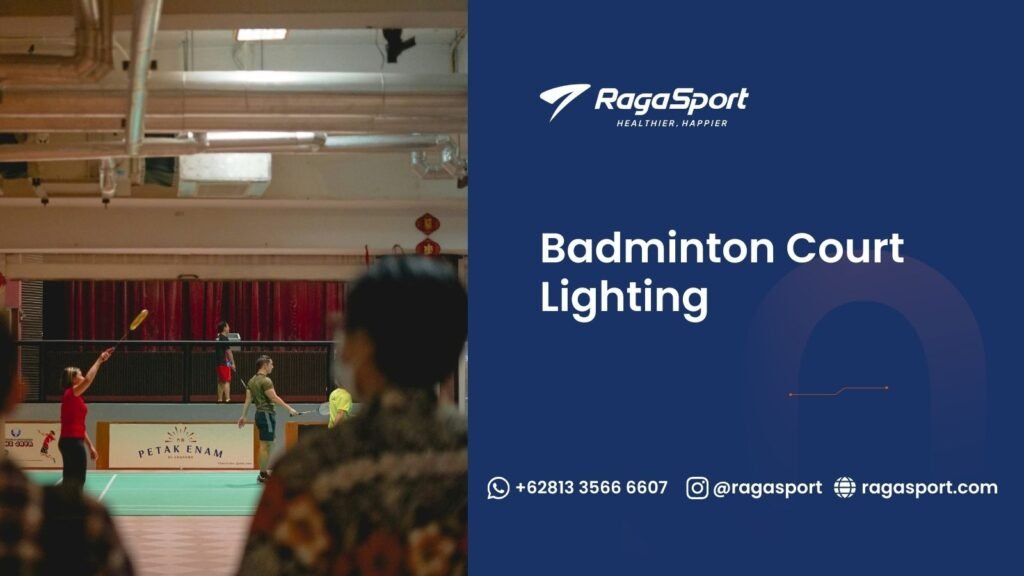
Badminton court lighting isn’t about making the court look bright. It’s about whether players can read the shuttle early, judges can make confident calls, and rallies flow without visual hesitation. In badminton, athletes spend a large portion of the game looking upward, tracking a small, fast object that changes speed and direction in milliseconds. That single fact makes lighting for badminton fundamentally different from most indoor sports—and also explains why many courts feel “tiring” to play on even when the lux meter says everything is fine.
This article looks at badminton court lighting from a practical, decision-making perspective: what level of light actually works, how poor fixture placement creates glare and visual blind spots, and which technical choices separate a recreational court from a competition-ready one. If you’re planning a new badminton facility or upgrading an existing hall, the goal here isn’t theory—it’s helping you avoid costly mistakes and arrive at a lighting setup that performs consistently for players, referees, and event organizers alike.
Lighting standards & recommended lux levels
Once you move past the idea of “just make it bright,” the next real question is simple but critical: how much light is actually enough for badminton? The answer depends on how the court is used—and this is where many facilities go wrong by aiming either too low (hard to play) or unnecessarily high (wasted energy, more glare).
For recreational and school-level courts, lighting in the range of 300–500 lux is generally acceptable. At this level, players can follow the shuttle comfortably for training and casual games, as long as the light is evenly distributed and glare is controlled. This is often where community halls and multi-purpose gyms should sit.
Move up to club-level and competitive play, and expectations change. Most guidelines point to around 500–750 lux for serious training and local competitions. At this level, reaction time improves, shuttle visibility is more consistent across the court, and players feel less visual fatigue during long rallies. This is also where uniformity starts to matter just as much as the average lux number.
For national and international tournaments, badminton authorities commonly reference 1000 lux or more. This isn’t about luxury—it’s about precision. At high speeds, even small drops in brightness or uneven patches of light can affect timing, judgment, and fairness. For courts intended to host elite events, lighting should be designed from the start with this benchmark in mind.
Things step up again for TV or broadcast-ready courts. Here, recommended levels often reach 1500–1600 lux, with a crucial twist: light isn’t only measured on the floor anymore. Vertical illuminance—how well players and the shuttle are lit from the camera’s point of view—becomes essential. A court can look bright to the eye but still fail broadcast requirements if faces, movements, and shuttle trajectories aren’t clearly captured on camera.
One important detail many people miss: these values usually refer to maintained lux, not the “brand new” brightness on installation day. Good lighting design assumes light output will gradually drop over time, so systems are specified to stay within target levels throughout their service life—not just at handover.
If you’re planning a badminton court, try asking yourself this:
Is this court for casual play, serious competition, or future tournaments and broadcasts?
That single answer should dictate your lux target—and everything that follows in the lighting design.
Glare & fixture placement rules
If a badminton court already meets the required lux level but players still complain about discomfort, missed shots, or eye fatigue, the issue is almost never brightness. It’s glare—and how the fixtures are placed.
Badminton puts unique stress on the visual system. Players repeatedly look upward to track a small shuttle moving fast against the ceiling and background. When light sources sit directly in that visual path, the eyes are forced to constantly adapt between extreme brightness and fine detail. That’s when performance drops, even on courts that look “bright enough” on paper.
The key rule professional badminton lighting follows is simple:
- High illuminance must never come with direct glare in the player’s line of sight
Where courts usually fail is fixture placement. A layout that looks efficient or symmetrical during construction often ignores how badminton is actually played.
Common placement mistakes include:
- Lights installed directly above the main playing area, especially over the center of the court
- Low mounting heights that place luminaires inside the natural upward viewing angle of players
- Uneven layouts, where one or two fixtures create glare only during high clears or defensive lifts
Good badminton lighting works the opposite way. Instead of shining light down onto players, it illuminates the court from the sides and from higher angles, keeping light sources out of direct view while still delivering uniform brightness.
Well-designed layouts typically aim for:
- Fixtures positioned outside the court boundaries, not above the net or center zone
- Sufficient mounting height so players don’t see the light source when tracking a high shuttle
- Consistent glare control across all luminaires, not just the main rows
One overlooked detail: glare problems often don’t show up during casual play. They appear during high rallies, defensive lifts, or long matches—exactly when visual fatigue accumulates. That’s why courts can feel “fine” at first, then frustrating after 30 minutes.
Here’s a quick on-site check anyone can do:
- Stand on the baseline
- Look up as if receiving a high clear
- Ask yourself: Do I see the shuttle first—or the lights?
If the lights dominate your vision, the layout is wrong, regardless of how high the lux reading is.
In badminton, great lighting is almost invisible. When fixture placement is done right, players stop thinking about the lights altogether—and that’s when a court truly performs at its best.
Uniformity & “quality metrics” beyond lux
Once glare and fixture placement are under control, the next thing that separates an average badminton court from a professional one is light quality. This is where many projects stop too early—because the lux target is met—while players still feel something is “off.” That missing piece is usually uniformity and consistency, not brightness.
In badminton, visual comfort isn’t about how bright one spot is, but how predictable the light feels as your eyes move across the court and follow the shuttle. When lighting quality drops, players don’t always notice it consciously—but reaction time, timing, and confidence start to slip.
Here’s the pro checklist that matters beyond lux:
- Uniformity (evenness of light)
A court with high average lux but dark patches near corners or baselines will feel uncomfortable fast. Players subconsciously adjust their timing when the shuttle moves through uneven lighting zones. That’s why professional designs prioritize balanced distribution, not just peak brightness. - Minimum light levels matter, not just the average
Two courts can both measure 750 lux on average, but the one with higher minimum values will always feel better to play on. Sudden drops in brightness are especially noticeable during fast rallies and defensive play. - Horizontal vs vertical lighting
Most people only think about light on the floor. In badminton, that’s not enough. The shuttle spends much of its time in the air, and players’ eyes follow it vertically. Good lighting ensures the shuttle remains clearly visible throughout its flight—not just when it’s near the ground. - Visual comfort over time
Poor-quality lighting doesn’t always fail immediately. It shows up as eye strain, headaches, or fatigue after long sessions. Courts that feel “harsh” usually suffer from a combination of uneven light and overly intense contrasts. - Consistency across multiple courts
In multi-court halls, each court should feel the same. When players move between courts and instantly notice a difference, uniformity across the venue has failed—even if each court technically meets the standard.
A simple way to sense lighting quality without instruments:
- Play a full game, not just a few rallies
- Notice whether your eyes feel relaxed or strained
- Pay attention to whether the shuttle ever “disappears” briefly against the background
If the lighting fades into the background of your experience, it’s doing its job.
Professional badminton lighting isn’t defined by one impressive number. It’s defined by how stable, comfortable, and predictable the visual environment feels—point after point, match after match.
LED specification checklist
Once you understand lux, glare, and uniformity, the next challenge is very practical: what exactly should you specify when choosing LED lights or briefing a contractor? This is where many badminton projects lose control—because decisions get reduced to wattage, brand names, or “this is what we usually install.”
A professional badminton court doesn’t start with products. It starts with requirements. Here’s a checklist you can actually use in discussions, tenders, or site meetings.
Start with the non-negotiables:
- Designed lux level (maintained, not initial)
Make sure the target lux is clearly stated for the court’s purpose (training, competition, tournament, broadcast). Avoid vague promises like “up to 1000 lux”—you want maintained performance over time. - Uniformity target included in the scope
Ask how evenness will be achieved, not just the average brightness. A contractor who talks about layout and distribution—not just lamp power—usually knows what they’re doing.
Now move to badminton-specific quality factors:
- Optics designed for glare control
LEDs must use optics or shielding that keep the light source out of direct player sightlines. “Bright but comfortable” should be the goal, not brute force illumination. - Fixture mounting height and position clearly defined
Demand drawings or simulations that show fixtures placed outside the court boundaries and above critical viewing angles. If placement is unclear, glare problems are almost guaranteed later. - Flicker-safe drivers
This matters more than many people realize. Flicker may be invisible at first but becomes an issue for fast movement, cameras, and long sessions. Especially important if the court may host events or video recording.
Then look at usability and long-term operation:
- Lighting control and zoning
Ask for multiple lighting scenes: training mode, match mode, full competition. Dimming flexibility saves energy and extends system life without sacrificing play quality. - Consistent color quality (CRI & color stability)
Good color rendering helps players judge shuttle speed and distance, and it’s essential for referees and recordings. Consistency across all fixtures matters more than chasing extreme numbers. - Durability for sports environments
Badminton halls aren’t gentle spaces. Fixtures should handle vibration, occasional impacts, and long operating hours without rapid degradation.
One final, often overlooked question to ask your contractor:
- “Can you show me another badminton court where this exact specification is already in use?”
Real experience beats brochures every time.
The right LED setup doesn’t announce itself with brightness. It proves itself quietly—through consistent play, fewer complaints, and a court that feels just as good in year three as it did on opening day.
Commissioning & on-site testing
The moment of truth for badminton court lighting doesn’t happen when the lights are switched on for the first time. It happens during commissioning—when the system is tested, measured, and proven to perform the way it was promised on paper. This step is often rushed or skipped, and that’s exactly why many courts technically meet specs but still underperform in real play.
Commissioning is about answering one simple question:
Does this court actually play the way it was designed to?
A proper on-site testing process usually starts with measurement, not impressions.
Key checks that matter for badminton include:
- Average and minimum illuminance (lux)
Measurements should be taken across a defined grid on the court, not just one or two “good-looking” spots. What matters isn’t the brightest area—it’s whether darker zones fall within acceptable limits. - Uniformity verification
This confirms that light is evenly distributed and that there are no sudden drops near baselines, sidelines, or net areas. Players feel these inconsistencies immediately, even if they can’t explain why. - Glare observation from player viewpoints
Numbers alone can’t detect glare. This part requires standing at realistic player positions—baseline, mid-court, defensive stance—and visually tracking where the eyes naturally go during a rally. - Vertical visibility check (especially for event-ready courts)
For higher-level or future broadcast use, it’s important to confirm that players and the shuttle remain clearly visible throughout high trajectories, not just near the floor.
Timing also matters. Commissioning shouldn’t be done in a rush or under “ideal” conditions only. Good practice includes:
- Testing after full installation and aiming are complete
- Confirming results at normal operating settings (not temporary max output)
- Documenting results as a baseline for future maintenance
One underrated but powerful step is a real play test:
- Play a full game
- Swap sides
- Rotate players
If multiple players independently say, “This feels easy on the eyes,” the lighting is doing its job. If comments start with “the back corner feels darker” or “that side is tiring,” the system still needs adjustment—no matter what the spreadsheet says.
Finally, commissioning isn’t the end of the story. The results should be:
- Recorded (lux maps, layout drawings, settings)
- Shared with the facility owner
- Used as a reference for future inspections or upgrades
In professional badminton lighting, commissioning is what turns design intent into real performance. It’s the difference between having lights and having a court players trust.
Great badminton court lighting isn’t defined by a single lux figure or a brand of LED—it’s defined by how the court performs when the game gets fast, intense, and demanding. When standards are chosen correctly, glare is controlled, uniformity is consistent, fixtures are specified with intent, and commissioning is done properly, lighting stops being a problem players talk about. It simply works. The shuttle stays visible, rallies feel natural, and the court earns trust—from athletes, referees, and event organizers alike.
If you’re planning a new badminton facility or upgrading an existing one, the real goal isn’t compliance—it’s playability over time. Decisions made at the lighting stage affect comfort, performance, maintenance cost, and even whether a court is suitable for competitions in the future. Get it right once, and you avoid years of complaints, retrofits, and wasted energy.
Thinking about building or upgrading a badminton court?
Talk to a specialist who understands badminton—not just lighting. At RagaSport, we design court lighting based on how the game is actually played, so your facility performs today and stays relevant tomorrow.
Contact RagaSport to discuss your badminton court lighting needs
From recreational halls to competition-ready venues, we help you get it right from the start.